- Straight from the prompt, the image carries no copyright: the Copyright Office finds prompts alone too thin for authorship (report of January 29, 2025).
- Your creative selection of outputs, your arrangement, your retouching: those human contributions can be protected.
- Adobe Stock demands an AI label, Etsy a disclosure in the listing description, Amazon KDP a declaration in books, and Shutterstock refuses them outright.
Theo, who is fictional, made a botanical wall print with Niki on a Sunday. On Monday his first buyer wrote with one question before paying: who owns the picture?
The print that raised the question
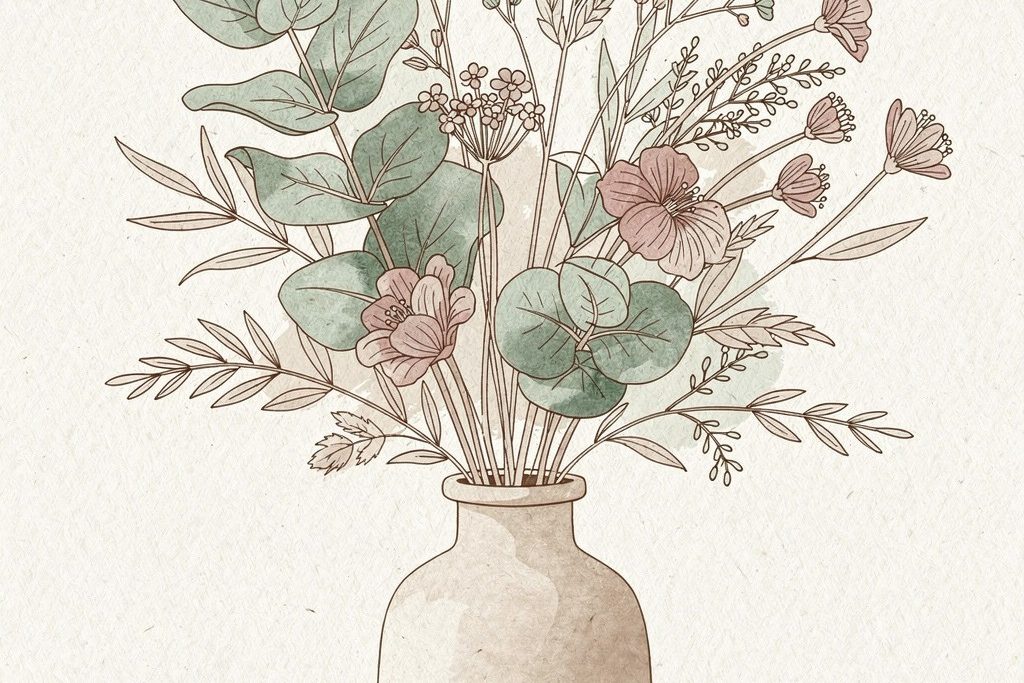
Here is the print he wants to sell.
Our AI image generator turns a description into a picture, or reworks a photo you send.
Botanical wall art
Create an original piece of printable wall art: a botanical still life with eucalyptus branches, dried grasses and a few wildflowers arranged in a simple ceramic vase, drawn in a delicate line style with soft watercolor washes in sage green, dusty pink and warm beige. Balanced composition with generous empty space, subtle paper texture, warm neutral palette that suits a living room. No text, no letters, no watermark anywhere in the image.
Niki made the print above with this prompt, exactly as written.
Who owns an AI image?
The U.S. Copyright Office took the question head on in its Part 2 report of January 29, 2025. Prompts, it concluded, “do not provide sufficient human control to make users of an AI system the authors of the output”, so copyright “does not extend” to what the machine produces on its own. No copyright attaches to the raw output. Selling it is another matter, and for that the marketplace rules decide.
Your own work fits inside the picture. The office counts the human work that shows in the image: a creative choice among outputs, an arrangement on the page, the retouching, the elements painted in. For registration, the March 16, 2023 guidance compresses it to one line: copyright “will only protect the human-authored aspects of the work”.
The courts agreed, and closed the door on a fully machine-made author. In Thaler v. Perlmutter, the D.C. Circuit affirmed on March 18, 2025 that a machine cannot be the author. The Copyright Act of 1976, it held, “requires all eligible work to be authored in the first instance by a human being”. On March 2, 2026, the Supreme Court let the decision stand by turning away the petition.
Registration follows the same line. Since March 16, 2023, an application must disclose the AI-generated content and describe your contribution in a few words; a print that came from a prompt alone leaves nothing human to claim, so the machine’s share is simply disclaimed.
Common belief
A long, detailed prompt makes me the author of the image.
In reality
The office asked exactly that and answered no for now: “Prompts alone, however, at this stage are unlikely to satisfy those requirements.” A future tool could change the answer, if prompts one day steer the expressive choices.
Where to sell AI art: the platforms’ own rules
Each marketplace writes its own conditions on top of the law. Five show the range a seller meets.
| Platform | Accepts AI images | What they ask |
|---|---|---|
| Adobe Stock | Yes | Label the upload: check “Created using generative AI tools” before submitting, also when AI edits changed or added the main subject; a model release for an identifiable person; no artist, real people or character names in prompts and titles; confirm you hold the rights. |
| Shutterstock | No | “Shutterstock does not accept AI-generated content from our contributors” (policy of July 16, 2025); the platform explains that ownership of AI content “cannot be assigned to an individual”. |
| Amazon KDP | Yes | Declare AI-generated images, cover included, when you publish or republish a book. Even with substantial edits afterwards, an image an AI tool created still counts as AI-generated, so the hand work never removes the declaration. Work only assisted by AI needs no declaration. |
| Etsy | Yes | Made with your own prompts and your creative input; the listing description must disclose the AI use; bot-generated content and AI prompt bundles stay out. |
| Redbubble | Not stated | The guidelines bar “Nude photography and realistic (including photorealistic AI-generated) imagery depicting nudity”. |
Adobe Stock guidelines updated June 11, 2026; Shutterstock policy dated July 16, 2025.
Policies move: before you list anything, check the live rules page of your platform.
What stays off the shelf
Before you list a print, check it against three families of content.
Brands
Logos and trademarks
A mark in your picture can infringe: the USPTO defines trademark infringement as unauthorized use “likely to cause confusion, deception, or mistake about the source of the goods”.
People
Recognizable faces
A real face brings a model release on Adobe Stock; California adds its own statute: Civil Code 3344 requires prior consent to use a person’s name, voice, photograph or likeness on merchandise (a state rule).
Characters
Known characters, living artists
Adobe Stock’s contributor rules bar “Names of artists, real people, or fictional characters” from prompts and titles, and breaches “may result in the removal of content or the termination of the account”.
Make the image yours in four steps
Protection follows the work you add. Four habits build the file you will want when a platform or a registration office asks questions.
-
Collect, then combine
Generate several outputs, keep the strongest and assemble them into one composition: a creative selection or arrangement is what the Copyright Office protects.
-
Retouch with intent
Work the chosen image by hand: crop, correct, repaint a detail, add an element; creative modifications count.
-
Write down your part
Keep a short note of the hand work: which outputs you kept, what you changed, what you added over the machine’s version.
-
Declare the AI part
When a marketplace form or a filing asks, declare the AI-generated content and describe your contribution in a few words.
More starting points sit in our library of image prompt examples.
Niki’s word of caution
Do not present an AI print as hand-painted; the buyer pays for a story the picture does not tell. The FTC’s chair at the time, Lina M. Khan, said on September 25, 2024: “Using AI tools to trick, mislead, or defraud people is illegal”; “there is no AI exemption from the laws on the books”. For a question on your own case, our legal AI assistant walks through the facts with you. General information, not legal advice.
Niki
AI image generator
“Send me a description or a photo to rework, in portrait, landscape or square; the trial is free, with a few messages and no account. I render in HD and the picture stays available for 48 hours: save it the moment you like it.”
Frequently asked questions
Do I own the picture Niki makes for me?
Not the raw output: the Copyright Office excludes purely machine-made images from copyright. Your creative additions and your creative arrangement can carry protection. A picture made with Nation AI is cleared for personal and professional projects alike, websites, ads, social media and print, provided you steer clear of trademarks, protected characters or real people’s likenesses. The permission to use is not a claim of exclusive rights.
Do I have to admit my picture is AI-generated?
On Adobe Stock and Amazon KDP, yes, in their forms: a label box or a disclosure question. On Etsy, the disclosure lives in the listing description itself. Shutterstock takes no AI submissions at all, so there is nothing to declare. When unsure, read the platform’s current form.
Will someone copy an AI print I sell?
The raw output carries no copyright, so copyright law gives you no claim on that part. What you added by hand, from retouching to arrangement, can be protected, and that is where your claim stands.
Can I register the work with the Copyright Office?
Yes, for the human part: the filing must disclose the AI-generated content, and only the human-authored aspects end up protected. A prompt-only print has nothing human to register.
Make the print, then make it yours
Describe your picture to Niki, save it in HD, and put your human work on top before the first listing.
Sources
- “Copyright and Artificial Intelligence”, report part 2 on copyrightability, U.S. Copyright Office, January 29, 2025.
- Registration guidance on AI-generated material (88 FR 16190), Federal Register, March 16, 2023.
- Thaler v. Perlmutter, decided March 18, 2025 (D.C. Circuit).
- Docket No. 25-449, Thaler v. Perlmutter, Supreme Court of the United States, March 2, 2026.
- Guidelines for generative AI content, Adobe Stock, updated June 11, 2026.
- Content policy updates for AI-generated images, Shutterstock, July 16, 2025.
- Content guidelines for books, Amazon KDP.
- What Can I Sell on Etsy?, Etsy Help.
- Community and content guidelines, Redbubble.
- About trademark infringement, USPTO.
- Civil Code 3344, use of a name or likeness, California Legislative Information.
- Press release on deceptive uses of AI, Federal Trade Commission, September 25, 2024.