
- A few months: nothing in the letter. A break of a year or more: one short sentence.
- AI can shape the structure; your facts and your final edits stay yours.
- Natalie drafts the letter from what you hand her; the trial is free, with no sign-up.
Maya is 34, fictional, and eight years into teaching high school English; this month she applies for her first instructional design job, and not one line of her resume says the words. The recruiter will spot the switch regardless, so her letter names it up front and connects the dots for them.
A career change cover letter, in full
Maya and Lumenvale Software, applicant and employer, are fictional; Natalie wrote the letter from Maya’s resume and the posting.
Natalie’s letter for Maya
Dear Hiring Manager,
I’m applying for the Entry-Level Instructional Designer position at Lumenvale Software. After eight years teaching high school English, I’m ready to bring my experience designing clear, engaging learning materials into software training.
In my current field, I’ve developed learning experiences for both schools and online learners. I led a curriculum project that was adopted by six schools and built an online writing course completed by 240 learners. These projects strengthened my ability to organize information, write and edit for clarity, and create materials that help learners make progress, skills that align closely with your need for clear learning content.
I’m making this career change because I want to apply my classroom experience to training that helps people use software effectively. My background gives me a strong foundation in understanding learners, explaining complex ideas, and shaping content around learning goals. I’m now looking to develop those strengths in an instructional design role and contribute to Lumenvale’s training materials.
I’d welcome the opportunity to discuss how my experience could support your team. Thank you for your consideration.
Sincerely,
Maya
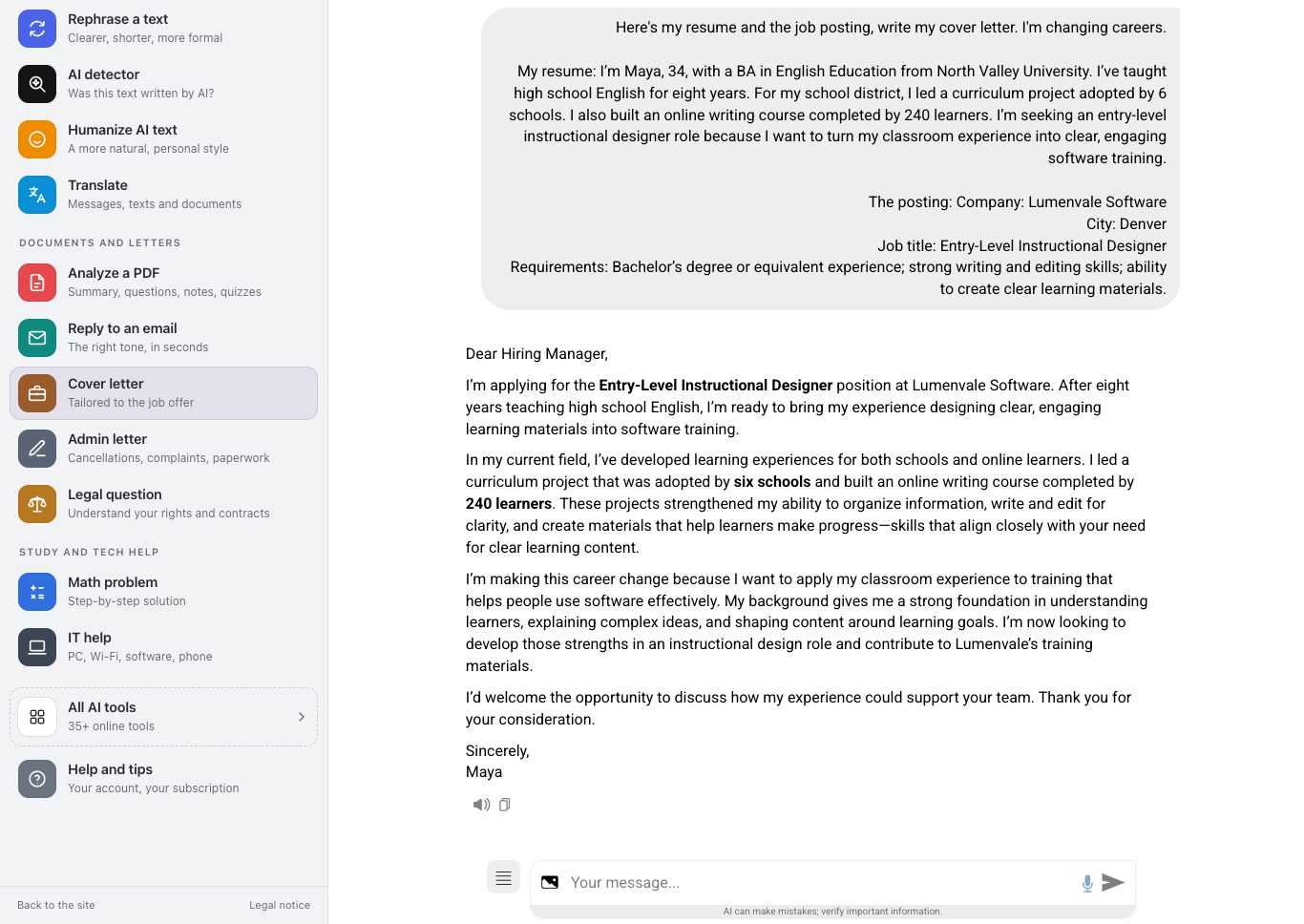
The letter runs 180 words on one page. Every claim comes out of what Maya handed over: two numbers from her old job, and a posting asking for strong writing and clear learning materials.
Why Natalie’s letter works
One more question from Maya
Nothing in my resume says instructional design. What here proves my teaching skills transfer?
“Your curriculum project shows you can design structured learning materials, and that six schools found them useful enough to adopt.”
“Your online writing course shows you can teach beyond the classroom and create content for independent learners.”
“Together, these examples connect your teaching experience to the role’s need for clear, engaging training materials, without implying you’ve worked in software.”
The third answer carries the letter: it meets the posting’s requirements in its own language, with results that carry numbers, not a summary of the resume. Natalie takes the two projects deeper than the resume can, the split career centers draw for career changers.
Write your own in four steps
-
Name the change yourself
The recruiter sees the career change coming, so the letter addresses it, plainly or subtly; Natalie’s letter for Maya names it in its first paragraph.
-
Answer the posting in its own words
Take the requirements one by one, answering each with its own wording; where you fall short, say which other experience makes up for it.
-
Choose old-job results that carry numbers
Two to four of them, each with a number, each pointing at a requirement of the new job.
-
Show your preparation for the field
Courses, a certification, volunteering, side projects: when the new field is missing from your history, the preparation is your evidence.
For a second worked sample, our cover letter examples page carries Dana’s full letter, a move from restaurant management into customer success.
The resume needs the same pass: our guide on how to make a resume with AI covers it.
How much to say about a gap or a pay cut
My gap lasted a few months
Leave the gap out entirely
“A month or two or three or four, don’t say anything in the cover letter,” says Lori Shreve Blake of the USC Career Center.
My gap lasted a year or more
Give it one sentence, in the body
Past a year, USC Online calls for a brief acknowledgment; UMGC’s career team puts it in a body paragraph.
I’m taking a junior or lower-paid role
Present it as your planned route
Name the drop, then tie it to long-term goals: the career services office at St. John’s University advises presenting it as strategic, not one forced by money.
What AI can and cannot write
Myth
The switch of field is awkward to explain, so hand the whole letter to a chatbot.
Reality
“AI can assist in organizing your ideas and providing initial structure,” the career office of the University of Redlands advises: a frame to start from. The experiences have to be yours, and so do the final edits.
One check before any of this: some schools, training programs and employers write their own AI rules, and theirs beat yours.
What Natalie will not do
She works from the facts you hand her and invents nothing: no experience you have not built goes in. The employer facts are yours, she sends nothing, and she promises no interview: you reread, you send.
Natalie
AI cover letter assistant
“My job is to find what holds your old path and your new job together, and I never treat the change as a flaw to excuse. Send me your resume and the posting; I draft from your facts alone.”
Turn the change into your strongest argument
Open our AI cover letter generator page, tell Natalie where you are headed, and she drafts the letter; the trial is free, with no sign-up.
Frequently asked questions
Do I have to explain the change of career in my letter?
Yes: the recruiter will spot the change, so the letter frames it. Address it, then spend the rest connecting your results to the requirements.
Should I bring up an employment gap?
It depends how long. A few months stays out; past a year, it earns one brief sentence in a body paragraph. UMass Global adds one exception: time off that made you a stronger candidate belongs in the letter.
What if I have never worked in the new field?
Then the preparation is your evidence: courses, a certification, volunteering, side projects all count, and Natalie draws arguments from course projects, summer jobs and volunteering without inflating your background. Our cover letter for an internship covers the same wall.
Is ChatGPT or another AI allowed for this letter?
University career centers accept it for structure and a first draft, with the final letter staying true to your experience and voice. Our own rule: check the AI rules of your school, program or employer first, and keep the facts yours.
Sources
- Northwestern-St. Paul, career blog on the career-change letter, February 14, 2022.
- Career-change letter examples, career services office of St. John’s University (a reprint of The Muse), July 10, 2025.
- How to explain a career break, USC Online, September 25, 2025.
- Dealing with an employment gap, career advice of UMGC, June 10, 2024.
- Explaining gaps in employment, blog of UMass Global.
- Cover letters and AI, career office of the University of Redlands.
- Generative AI for careers, University of New Hampshire.
A last pass before you hit send
Alex, Nation AI’s generalist assistant, gives your letter and your resume a final read.