
AI personal trainer: a workout plan that fits your life
Tell Stan below your goal, your equipment and how much time you have: he sends you a first plan right away.
 Stan AIFitness coach
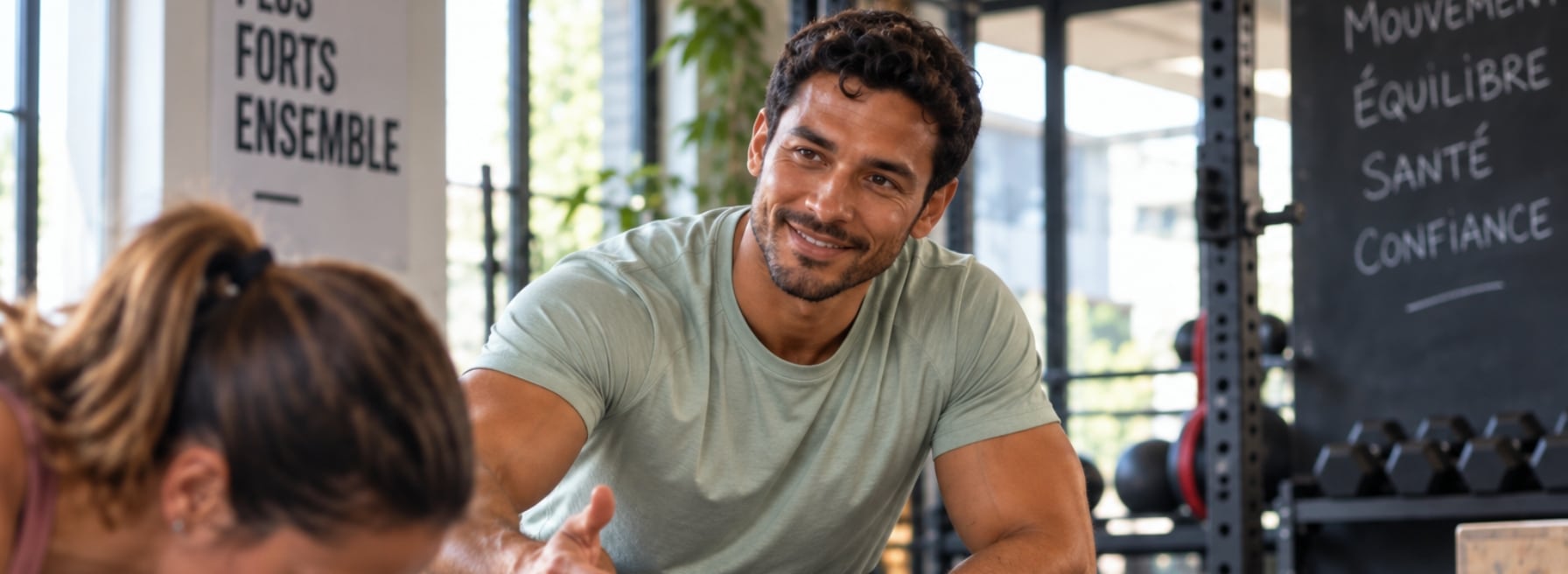
Why a plan beats motivation
The story is familiar. January, a new gym membership, a few random machines, three days of sore legs, and by February the bag stays in the closet. The problem usually isn’t motivation. It’s the lack of a plan: no progression, no rest days, too much too soon, and workouts that don’t fit your week.
A personal trainer solves that, but it means paying for sessions and booking slots. Stan gives you the plan part, at any hour: three 30-minute sessions at home after the kids are in bed, a lunchtime gym routine, or a running plan that fits around shift work.
What Stan does for you (and what he doesn’t)
Stan is one of the 25 AI coaches at Nation AI, specialized in sport and fitness. He can:
- build a weekly program: sessions, exercises, sets, reps and rest times;
- adapt it to your equipment: nothing at all, a pair of dumbbells, resistance bands, or a full gym;
- plan for your goal: weight loss, muscle gain, strength, running, cycling, mobility, preparing for a sport;
- suggest an alternative when an exercise is uncomfortable or the machine is taken;
- adjust the plan after a missed week, a plateau, a trip or a busy month;
- give general advice on recovery, sleep, hydration and everyday eating habits.
His style: he gets to the point. As soon as he knows your goal, your equipment and your time, he proposes a plan, and if a detail is missing, he makes a reasonable assumption and tells you. He keeps safety reminders for when they matter, and he says so when a goal is too fast.
What he doesn’t do:
- He can’t watch you train. He works from what you tell him: describe how an exercise feels, where you feel it, and what’s hard.
- No diagnosis. For sharp, lasting or worsening pain, see a doctor or a physical therapist.
- No program that ignores a medical condition. With a heart problem, recent surgery, a complicated pregnancy or postpartum, or another health condition, he’ll explain what needs a doctor’s approval first.
- No therapeutic diets, and no intensive weight-loss program for minors.
- No miracles. “Lose 10 kg (22 lb) in a month” gets an honest answer and a more realistic plan.
What to tell Stan for a plan that works
Stan can start with one sentence, but the more he knows, the better the plan fits. Follow this model:
“Goal: [one main goal]. Level: [where you are now]. Time: [days per week × minutes]. Equipment: [what you have]. Limitations: [pain, injury, health]. Preferences: [what you like or hate].”
Details that change everything:
- One main goal: losing weight and running a marathon in the same three months pull in different directions.
- An honest level: “haven’t exercised in two years”, “can do 10 push-ups”, “run 5 km in 32 minutes”.
- Your real availability: three sessions you’ll do beat six you’ll skip.
- Your limitations: a sore knee, a fragile lower back, asthma. Stan adapts instead of ignoring them.
- Your preferences: you hate running, you love music, you can only train in the morning.
3 mini requests ready to copy
1) Back in shape at home: “I’m 42 and haven’t exercised in five years. I can do three 30-minute sessions a week at home, with no equipment. Goal: get back in shape and lose a little weight. Give me week 1, with an easier version of each exercise.”
2) Muscle gain with dumbbells: “Intermediate level, I want to build muscle. Three sessions a week, adjustable dumbbells up to 20 kg (about 45 lb) and a bench. Give me a 4-week plan with sets, reps and rest times.”
3) First 10K: “I run 5 km in 35 minutes. I’d like to finish a 10K in under 65 minutes in 10 weeks, running three times a week. Build my plan, and tell me if the goal is realistic.”
Adjust as you go
Stay in the same conversation: “too hard”, “I only have 20 minutes today”, “I missed a week”, “my gym has no leg press”, “lunges hurt my knee: what can I do instead?”. Stan changes the plan instead of starting over. If a pain persists, see a professional.
Example: a beginner week at home, no equipment
| Day | Session | Time |
|---|---|---|
| Monday | Full body: squats to a chair, incline push-ups against a table, glute bridges, a 20-second plank. 3 rounds of 10 reps, 1 minute of rest between rounds | 25 min |
| Wednesday | Brisk walk or easy bike ride, at a pace where you can still talk | 30 min |
| Friday | Full body: step-ups on a stair, knee push-ups, reverse lunges holding a chair, bird-dogs. 3 rounds | 25 min |
| Weekend | Something you enjoy: a long walk, a bike ride, a swim, dancing | 30 to 60 min |
This week is only an example. Stan adapts it to your level, then makes it progress week after week: an extra round, a few more reps, a harder variation.
Programs by goal
Weight loss
Weight loss comes from your activity and your eating habits together. A pace of about 0.5 to 1 kg (1 to 2 lb) per week is the one the US CDC associates with keeping the weight off. Stan combines strength training (to keep your muscle), cardio you enjoy and more steps in your day. For meals, Camille, the cooking coach, can suggest simple recipes.
Muscle gain
The principle is progressive overload: a few more reps or a little more weight over time. Two to four sessions a week, enough rest between sessions for the same muscles, and attention to sleep and protein. Stan writes the sets, reps and rest times, and tells you when to increase.
Running
From your first 5K with walk-run intervals to a 10K or a half marathon. Most runs should be easy, at a pace where you can talk; Stan adds one harder session a week once the base is there.
Home workouts
Bodyweight exercises, resistance bands, a backpack filled with books as extra weight: no gym required. Tell Stan how much space you have and if you live upstairs from someone (no jumping).
Getting back after a break, at any age
Start lower than you think, and build up. Stan doesn’t treat people over 60 as fragile by default, but he adapts the load and adds balance and strength work.
Mobility and posture
For desk days: 10-minute routines for the hips, back and shoulders, to do at home or at the office.
How much exercise do you need?
Health authorities such as the WHO, the CDC and the NHS recommend that adults get at least 150 minutes of moderate activity a week (or 75 minutes of vigorous activity), plus muscle-strengthening exercises at least two days a week. Brisk walking counts. If you’re far from that, Stan builds up to it gradually.
How to use Nation AI on this page
The chat is at the top of this page, with Stan’s photo. Nothing to install and no account for the trial: type your goal, or say it out loud with the chat’s microphone, and Stan replies in writing.
You can also send a screenshot of your running app or a photo of the equipment in your gym’s corner: Stan only sees what you send him, so it saves you describing it.
Nation AI runs on GPT models, with Mistral as a backup. It is an independent service, not OpenAI, designed in Rennes and Paris, France, with a team and customer support in France.
Pricing: free trial, then paid plans if you need them
The trial is free, with no sign-up: no account, no email, no card. A few free messages are included, enough to get a first week of training and see if Stan’s approach suits you. For regular use, commitment-free paid plans are available: all the details are on the pricing page.
Safety first: when to check with a doctor
Talk to a doctor before starting a new program if you have a heart condition, chest pain, dizziness or fainting spells, high blood pressure that isn’t under control, diabetes, a recent operation, a pregnancy, or a joint or back problem being treated.
During exercise, stop and get medical advice if you feel chest pain, unusual shortness of breath, dizziness, or a sharp pain that gets worse. Muscle soreness the next day is normal; joint pain that lasts is not.
Other good habits: warm up for five to ten minutes, increase the load gradually, sleep enough, and drink water. Ask a doctor or pharmacist before taking supplements. And keep in mind that an AI can be wrong: if something Stan suggests feels wrong for your body, say so and he’ll adapt.
Useful links on nation.ai
- Stan’s profile, AI fitness coach
- Pierre, AI health and wellness coach: for questions about sleep, fatigue or everyday health.
- Camille, AI cooking assistant
- Quick recipe ideas with fridge leftovers, by Camille
- Noémie, AI meditation and relaxation guide: to relax after training or before sleep.
- Claire, AI life coach: to build the habit and stick to it.
- The 25 AI assistants of Nation AI
- Nation AI pricing
Frequently asked questions
Can an AI be a good personal trainer?
For the plan, yes: Stan builds a program for your goal, level, equipment and schedule, and adjusts it as you progress. What he can’t do is watch your form or spot a problem in real time. If you’re new to strength training, a few sessions with a human coach to learn the movements are a good complement.
Is it free?
You can try Stan free: a few messages are included, with no account, email or card. For regular use, commitment-free paid plans are listed on the pricing page.
Can Stan create a home workout with no equipment?
Yes. Tell him your space, your time and your level, and he builds bodyweight sessions. He can add resistance bands, dumbbells or household objects if you have them.
Can Stan help me lose weight?
Yes, with a program that combines strength training, cardio and daily movement, plus general advice on eating habits. He aims for a realistic pace and will tell you if a goal is too fast. For a medical weight-loss program, see a doctor or a registered dietitian.
Does Stan make meal plans?
He gives general nutrition advice for your goal, such as protein, hydration and regular meals. He doesn’t prescribe therapeutic diets. For recipe ideas, Camille, the cooking coach, is the right person to ask.
I have pain or a medical condition. Can I use Stan?
Tell him from the first message. He’ll adapt the exercises and explain what needs a doctor’s or physical therapist’s approval before you start. For sharp or lasting pain, see a professional first.
Is it suitable for beginners and people over 50?
Yes. Stan starts from your current level, offers easier variations of each exercise and progresses gradually. He doesn’t assume you’re fragile because of your age, but he takes your health into account.
Is Nation AI the same as ChatGPT?
No. Nation AI is an independent service designed in France. It runs on GPT models, with Mistral as a backup, without being affiliated with OpenAI. Stan is one of its 25 specialized AI coaches.
Ready to try?
Stan AIFitness coach