- As early as 1950, Alan Turing was asking whether machines can think.
- The first programs that worked: Arthur Samuel’s checkers in 1952, the Logic Theorist in 1956.
- Alex is free to try: a few free messages, with no account or card needed.
Tonight, the question keeps coming back: who invented artificial intelligence? You type it to Alex, Nation AI’s generalist assistant. His answer comes back: no one invented it alone. Behind it stand faces, places, the exact day the words appeared, and a date repeated one year too late.
Your late-night question, put to Alex
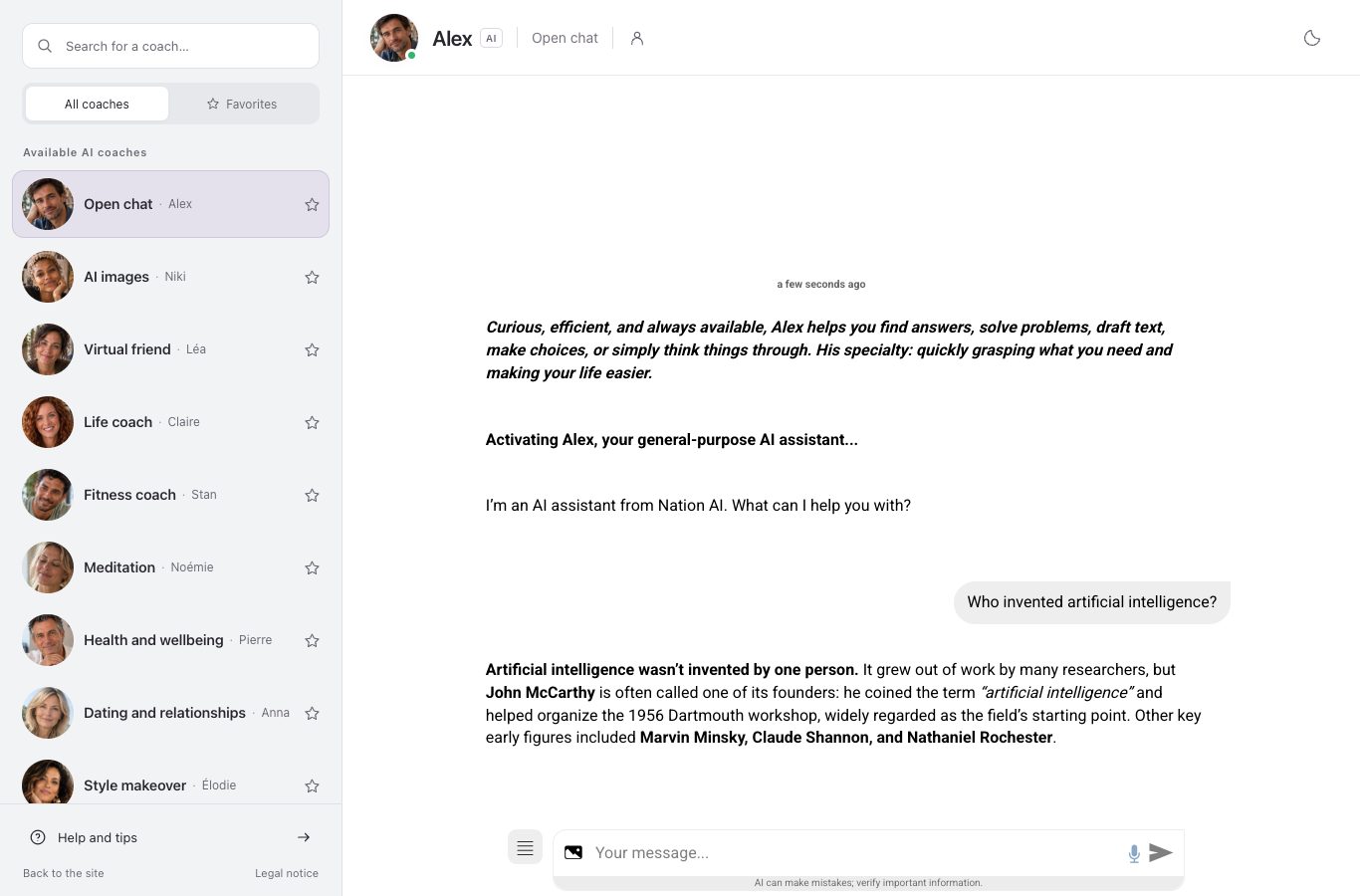
In the Nation AI chat, you type: “Alex, where does artificial intelligence come from, and who invented it?”
“Artificial intelligence wasn’t invented by one person. It grew out of work by many researchers, but John McCarthy is often called one of its founders: he coined the term “artificial intelligence” and helped organize the 1956 Dartmouth workshop, widely regarded as the field’s starting point.”
“Other key early figures included Marvin Minsky, Claude Shannon, and Nathaniel Rochester.”
He is right: no single person invented artificial intelligence. The story starts in Manchester, and it passes through a document dated to the exact day.
Manchester, 1950: Alan Turing’s question
“I propose to consider the question, ‘Can machines think?'”
The imitation game sets three players against one another: a man, a woman and an interrogator, who sees only their messages and must say which is which.
Turing himself judged the original question “too meaningless to deserve discussion”: his article replaces it with the game, and speaks of “the machine now working at Manchester”.
The simple version? Alex gives it in the same conversation.
A sample conversation
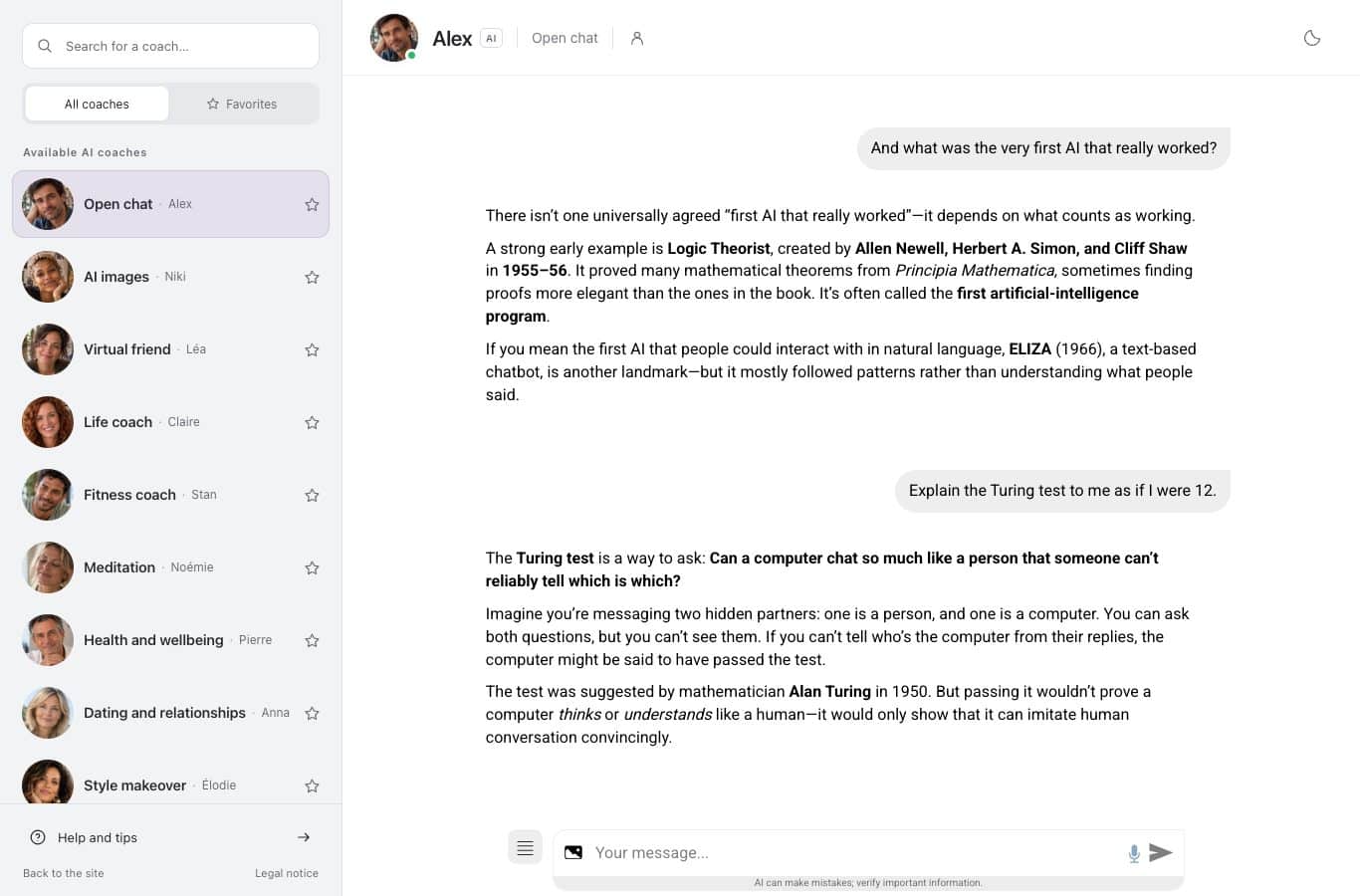
Alex, explain the Turing test simply, as if I were 10.
“The Turing test is a way to ask: Can a computer chat so much like a person that someone can’t reliably tell which is which?”
“Imagine you’re messaging two hidden partners: one is a person, and one is a computer. You can ask both questions, but you can’t see them. If you can’t tell who’s the computer from their replies, the computer might be said to have passed the test.”
Artificial intelligence finds its name on August 31
Five years later, on August 31, 1955, a typewriter lines up the title of a summer project on artificial intelligence.
Four names at the top: John McCarthy (Dartmouth College), Marvin Minsky (Harvard), Nathaniel Rochester (IBM) and Claude Shannon (Bell Telephone Laboratories). In it, they ask for “a 2 month, 10 man study of artificial intelligence” for the summer of 1956 in Hanover, New Hampshire.
The bet: “every aspect of learning or any other feature of intelligence can in principle be so precisely described that a machine can be made to simulate it.”
Common belief
The words “artificial intelligence” were supposedly born at the 1956 conference, or with Turing.
In reality
They are in the title of the document dated August 31, 1955, signed by four researchers; the workshop came the following summer.
The workshop, the next summer, is organized by John McCarthy: eight weeks of work, about twenty scientists, some present all summer, others for a few hours, according to the Dartmouth Alumni Magazine. Dartmouth College sees in it “the birth of this field of research”.
The first programs that worked
The seed is planted in December 1943: Warren McCulloch and Walter Pitts describe, in biophysics, a model of an artificial neuron.
1952
Arthur Samuel’s checkers program
Written for the IBM 701 in 1952, it goes on to learn to play better than its author.
1956
The Logic Theorist
Allen Newell and Herbert Simon, at RAND, use it to rediscover proofs of logic theorems.
1958
The perceptron
Frank Rosenblatt describes a probabilistic model inspired by the brain, simulated on the IBM 704 of the Cornell Aeronautical Laboratory.
1966
ELIZA
At MIT, Joseph Weizenbaum makes conversations in natural language possible between man and computer.
Asked in the same conversation about the very first working AI, Alex says it all depends on what you count as working.
Our article on ELIZA tells what came next.
The long silence, then the return
Enthusiasm falls. In July 1972, James Lighthill hands a severe report to the British Science Research Council, in which most researchers “confess to a pronounced feeling of disappointment in what has been achieved in the past twenty-five years”.
-
May 1997
Deep Blue (IBM) beats the world chess champion, Garry Kasparov, in a match.
-
2018
Yoshua Bengio, Geoffrey Hinton and Yann LeCun receive the Turing Award for deep neural networks.
-
November 30, 2022
OpenAI, a startup then unknown to the general public, launches ChatGPT.
-
October 8, 2024
Nobel Prize in Physics: John Hopfield and Geoffrey Hinton, for discoveries that make machine learning with artificial neural networks possible.
Our article on the creation of ChatGPT tells the story of OpenAI.
To sort the families of AI, read our article on the four types of artificial intelligence.
Alex’s tip
For a paper, give the date of the document, not the date people repeat: the words are in the proposal of August 31, 1955, the workshop is the summer of 1956. Looking for sources? Cite the original texts: the 1955 proposal is in the list at the bottom; Turing’s article is “Computing Machinery and Intelligence”, Mind, 1950.
Alex
Generalist AI assistant
“A date escapes you, a notion stays obscure: I explain things simply, and when I am not sure, I prefer to say so rather than invent.”
Need something more specific? The 25 coaches of Nation AI cover every goal: our AI assistants page introduces them.
Frequently asked questions
Who invented the term “artificial intelligence”?
It sits in the title of the proposal dated August 31, 1955, signed by McCarthy, Minsky, Rochester and Shannon; the alumni magazine credits the whole group.
In which year was artificial intelligence born?
The words date from 1955, the field of research from 1956. France’s Ministry for Higher Education and Research describes a notion forged in the mid-1950s, after Turing.
Did Alan Turing invent artificial intelligence?
No. He poses the question in 1950 and imagines an imitation game; the field is born six years later from the work of a group. Turing himself called the original question “too meaningless to deserve discussion”.
What was the first artificial intelligence?
That depends on what “working” means: Arthur Samuel’s checkers program runs as early as 1952, and the Logic Theorist proves theorems in 1956.
The next question is yours to ask
Alex answers your questions, on the history of AI or on anything else: a few free messages, with no account or card needed.
Sources
- A Proposal for the Dartmouth Summer Research Project on Artificial Intelligence, August 31, 1955, scanned copy.
- Artificial Intelligence (AI) Coined at Dartmouth.
- The Logic Theory Machine, RAND Corporation, 1956.
- ELIZA, Communications of the ACM, 1966.
- Artificial Intelligence: A General Survey, James Lighthill, July 1972.
- Deep Blue, IBM.
- 2018 Turing Award, ACM.
- 2024 Nobel Prize in Physics, press release.
- Artificial intelligence (AI): what are we talking about?, France’s Ministry for Higher Education and Research, published June 10, 2025.