
The survey in four lines

37% of French adults used artificial intelligence to flirt this summer, and another 29% thought about it without going through with it.
58% of those users have it write their messages, 53% ask it what to reply, 49% use it to decode the other person’s intentions.
43% never admitted that a machine was writing for them, and 16% intend never to say so.
For advice about their love life, AI (17%) now ranks ahead of family (14%).
What if your next spark had been whispered, word for word, by an artificial intelligence? This summer it became hard to tell who is really behind the burning messages landing in dating apps: the person you like, or their AI.
We wanted to measure that shift precisely. From 23 to 30 July 2026, Nation.fr surveyed 4,106 people in France about how they use artificial intelligence in their love lives: writing a first message, decoding the other person’s intentions, picking a profile photo, preparing a breakup, or simply asking for advice. Here are the full results, question by question, with the complete methodology and an infographic that is free to reuse.
- AI moves into our love lives
- Ghostwriter, decoder and coach
- The whole study in one image
- How far the delegation goes
- Six stories out of ten start with a secret
- Happy to cheat, not to be cheated
- Looks under the algorithm’s filter
- AI dethrones family in our secrets
- Computer-assisted breakups
- And you, how far would you go?
- When our AIs flirt with each other
- Full methodology

“Is seduction turning into a matter of technology, or of nerve? Behind these figures there are people who often did not dare to make the first move: AI gave them the courage to send that first message, to find the right word, sometimes even to say goodbye more gently. One question this survey raises forcefully remains: at what point does a helping hand become a pretence? That is the whole challenge of the years ahead, and we find it fascinating.” (translated from the original French)
Emmanuel Françoisefounder of Nation.fr
AI moves into the love lives of more than one French adult in three
This is the figure that sums up the summer of 2026: 37% of French adults admit having turned to artificial intelligence in a flirting context, at least once. This is no longer a niche habit for tech enthusiasts, it is a mass reflex that settled in within a few months.
More telling still: another 29% have thought about it without going through with it. Added together, those two groups make up nearly two French adults out of three who no longer rule out handing their love life to an algorithm. On the other side, only 31% dismiss the idea outright.
| Answer | Share of respondents |
|---|---|
| Yes, at least once this summer | 37% |
| No, not this summer, but I have thought about it | 29% |
| No, never, and it would never cross my mind | 31% |
| Don’t know / prefer not to say | 3% |
A groundswell, not a summer accidentOur previous national study, run in May 2026 among 3,801 people in France, already showed that people no longer only ask AI to work for them: they also hand it their doubts and their private lives. This summer’s survey measures the next stage, the one where love talk turns into action. Further reading: what French adults really confide in AI (in French).
Ghostwriter, decoder and coach: what the AI is actually used for
Among users, AI is first and foremost a pen. 58% use it to write or polish a message to the person they like, and 53% to find something to reply when inspiration runs out. Staring blankly at a screen has become a problem people outsource.
The unsettling part is elsewhere. Nearly one user in two (49%) relies on it to decode incoming messages and read the other person’s intentions. The tool is no longer only there to speak: it is there to read the other person’s mind, or at least to give that impression.
Then come planning the date (44% ask it for date ideas), image (42% to pick or retouch profile photos, 31% to write the bio) and two more intimate areas: 29% ask it for sexual advice, and 28% have it prepare a difficult conversation.
| Declared use | Share of users |
|---|---|
| Writing or improving a message to someone I like | 58% |
| Finding something to reply when I did not know what to say | 53% |
| Decoding a message and understanding the other person’s intentions | 49% |
| Coming up with date or outing ideas | 44% |
| Picking or retouching my profile photos | 42% |
| Writing my bio on a dating app | 31% |
| Getting sexual advice | 29% |
| Preparing a difficult conversation: a confession, a breakup or clearing the air | 28% |
| Getting advice about my looks or my outfit | 21% |
| Something else | 4% |
The whole study in one image
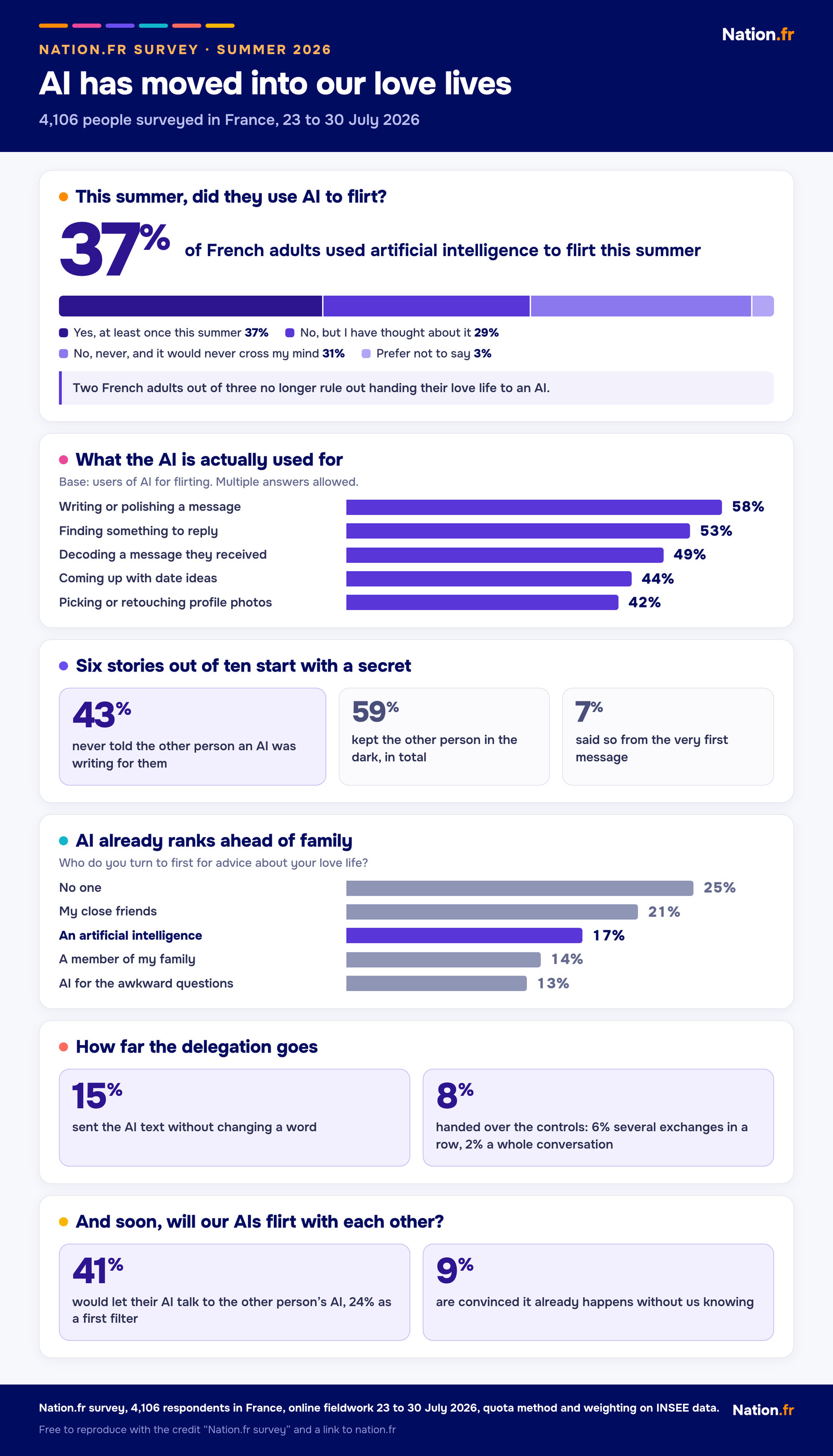
Here are the main findings of the survey gathered on a single sheet, designed to be read in a few seconds and shared as it is.
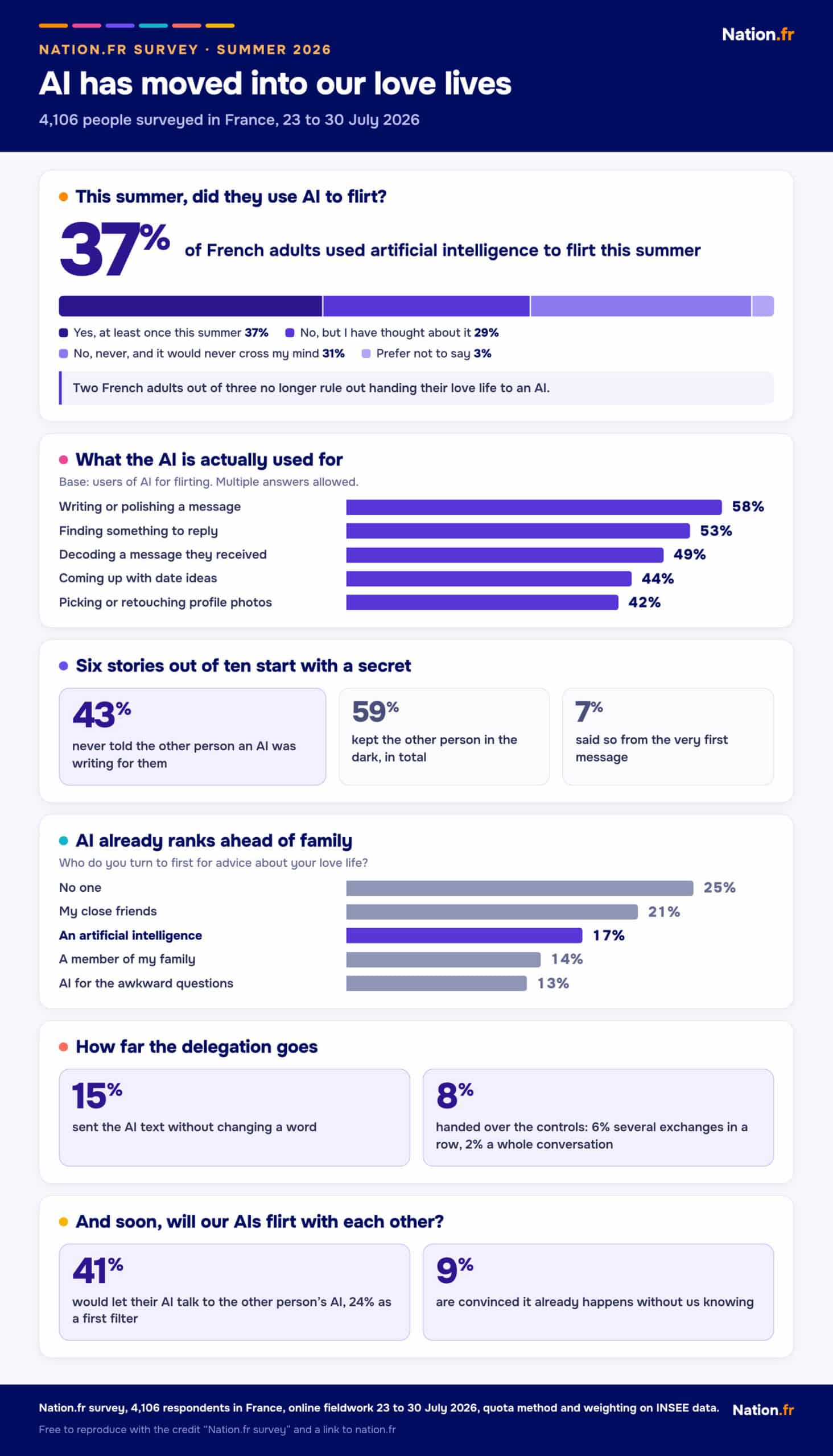
Free to reuse. Journalists, bloggers, creators: this infographic and the figures from the study may be reproduced freely, provided you credit “Nation.fr survey” and add a link to nation.ai. The high-resolution file is available here.
One user in five lets the AI speak for them
Many people keep control: 31% of users only take ideas from it before rewriting everything themselves, and 17% ask for nothing more than a spelling fix or a rewording. But the line is moving fast.
15% have already sent an AI text without changing a word. And nearly one user in ten (8%) has handed over the controls outright: 6% let it handle several exchanges in a row, close to autopilot, and 2% had it run an entire conversation, from the first message to the date.
| Level of delegation | Share of users |
|---|---|
| It only fixed my spelling or reworded my sentences | 17% |
| It suggested ideas, but I rewrote everything myself | 31% |
| I sent its text after tweaking it slightly | 28% |
| I sent its text as it was, without changing anything | 15% |
| I let the AI handle several exchanges in a row, almost on autopilot | 6% |
| I had it run a whole conversation, from the first message to the date | 2% |
| Don’t know / prefer not to say | 1% |
Six stories out of ten start with a secret
The secret is well kept. 43% of users never admitted that an AI was writing for them, and the other person never found out. 16% intend to take the secret to the grave. Add the 13% whose partner suspected it or worked it out alone, and nearly six users in ten (59%) left the other person in the dark.
Transparency, on the other hand, stays a minority position: only 7% said so from the first message, and 12% admitted it later.
| Answer | Share of users |
|---|---|
| Yes, I told them from the start | 7% |
| Yes, but I told them later | 12% |
| No, and they never found out | 43% |
| No, but they suspected it or discovered it | 13% |
| No, and I intend never to tell them | 16% |
| Don’t know / prefer not to say | 9% |
Spotting a text written by an AIThat 43% figure explains why the question “is this them, or their assistant?” now comes up in romantic conversations. The clues exist, but they fade as models improve: you can run your own texts through our free AI text detector.
Happy to cheat, not to be cheated
Tolerance has limits, and it is above all conditional. 32% would judge the situation case by case: a helping hand, fine, a whole conversation, never. It is by far the majority answer, and it says everything about the line French adults draw between assistance and pretence.
Behind it, nearly a third would react badly: 17% would feel betrayed, as if they had been lied to, 11% would mostly be disappointed at having been won over by a machine, and 8% would cut off all contact immediately. At the other end, only 15% would greet the news with detachment or amusement.
| Reaction | Share of respondents |
|---|---|
| It would depend entirely on the degree: a helping hand yes, a whole conversation no | 32% |
| I would feel betrayed, as if I had been lied to | 17% |
| It would make me uncomfortable, nothing more | 15% |
| I would mostly be disappointed at having been won over by a machine | 11% |
| It would not bother me at all, it is a tool like any other | 8% |
| I would immediately cut off all contact with that person | 8% |
| It would amuse me, I would laugh about it with them | 7% |
| Don’t know / prefer not to say | 2% |
Mirror, AI, mirror: looks under the algorithm’s filter
Appearance goes through the mill too. 18% of French adults have already asked an AI to pick their best photos, 15% to choose their outfit for a date, 14% for an honest opinion on their looks, and 12% openly display a photo retouched or generated by AI on their profile.
The most telling answer comes from the reluctant. 45% of those who never tried would still like to know the machine’s verdict on their appearance, against 31% who flatly refuse to let an algorithm judge their looks. Curiosity already outweighs rejection.
| Answer | Share of respondents |
|---|---|
| No, but I would be curious to hear its opinion | 45% |
| No, I do not want a machine judging my appearance | 31% |
| Yes, I asked it to select my best photos | 18% |
| Yes, I changed my outfit for a date | 15% |
| Yes, I asked it for an honest opinion on my looks | 14% |
| Yes, I used a photo generated or retouched by AI on my profile | 12% |
| Yes, I changed my haircut or my style on its advice | 7% |
| Don’t know / prefer not to say | 2% |
Those 12% of profiles illustrated with a retouched or generated image raise a very practical question, that of likeness. On that ground we have measured elsewhere what free tools actually agree to do with a personal photo, and at what price: see our investigation into AI headshot generators and our comparison of the services that really accept your photo as input.
AI already dethrones family in our romantic secrets
This is probably the most striking result of the survey. Asked who they turn to first for advice about their love life, 17% of French adults name an artificial intelligence. That is more than their own family (14%), and not far behind close friends (21%).
Add the 13% who keep AI for the awkward questions and their circle for everything else, and nearly a third of French adults have already made it their romantic confidant. A quarter (25%) still tell no one, and only 5% turn to a professional.
| Confidant | Share of respondents |
|---|---|
| No one, I keep it to myself | 25% |
| My close friends | 21% |
| An artificial intelligence | 17% |
| A member of my family | 14% |
| It depends: AI for the awkward questions, my circle for the rest | 13% |
| A professional: psychologist, therapist or coach | 5% |
| Strangers online: forums or social media | 3% |
| Don’t know / prefer not to say | 2% |
Why AI wins that slotIt is not about the quality of the advice, it is about social cost. Asking a silly question, admitting to jealousy, rereading a message ten times: in front of an AI, none of that is paid for in judgement, sighs or gossip. Our survey shows that 13% of French adults make exactly that split, AI for what is awkward, their circle for the rest.
Computer-assisted breakups
We already had the breakup by text, by email or by voice note. Here comes the breakup proofread by an AI. 19% of French adults have used one to find the right words without hurting the other person, 15% to soften a message they had already written, 13% to prepare what they were going to say face to face, and 7% had it write the breakup message in full.
AI also acts as a crutch for the one left behind: 16% called on it to cope with a breakup they were on the receiving end of, 11% to answer the messages that followed, and 11% to decide whether to break up at all.
The practice is still far from accepted, though: 38% consider it plainly unacceptable for a moment that delicate.
| Answer | Share of respondents |
|---|---|
| No, never, it strikes me as unacceptable for a breakup | 38% |
| Yes, to find the right words without hurting the other person | 19% |
| No, but I have thought about it | 18% |
| Yes, to help me cope with a breakup I was on the receiving end of | 16% |
| Yes, to soften or reword a message I had already written | 15% |
| Yes, to prepare what I was going to say face to face | 13% |
| Yes, to help me decide whether to break up or not | 11% |
| Yes, to answer the messages received after the breakup | 11% |
| Yes, to anticipate the other person’s reactions or answers | 10% |
| Yes, to write the breakup message in full | 7% |
| No, I have never had to break up with anyone | 3% |
| Don’t know / prefer not to say | 1% |
And you, how far would you let an AI flirt for you?
Five questions from the survey, this time asked of you. After each answer, the comparator shows the exact share of the 4,106 respondents who made the same choice, and places your level of delegation. No data is sent anywhere: everything is computed in your browser.
Compare yourself with the 4,106 respondents
Your answers stay in your browser. The percentages shown are those of the Nation.fr survey of July 2026.
Your answers against the 4,106 respondents
| Question | Your answer | Answered like you |
|---|---|---|
| Use this summer | Yes, at least once | 37% |
| Message delegation | Fixing my spelling, nothing more | 17% |
| Transparency | Yes, from the very first message | 7% |
| Confidences | My close friends | 21% |
| AI-to-AI dating | No, it would remove all the point | 21% |
Delegation index: 2 out of 15 possible points
You are still in charge: the AI proofreads at most, you write and you own your words.
The four profiles of the comparator
| Index | What it says about you |
|---|---|
| 0 to 2 points | You are still in charge: the AI proofreads at most, you write and you own your words. |
| 3 to 6 points | You use it as a draft: it suggests, but you still decide every sentence. |
| 7 to 10 points | You genuinely delegate: part of what the other person reads no longer comes from you. |
| 11 to 15 points | You hand over the wheel: the helping hand has become an autopilot. |
Want to write it yourself, only better? The Nation AI dating coach helps you find the right tone, without sending the message for you.
And soon, our AIs will flirt with each other
The idea of algorithms flirting with each other to test our compatibility no longer belongs to science fiction. 41% of French adults are open to it: 24% would let their AI talk to the other person’s as a first filter before any real contact, 11% on condition that they can read the conversation, and 6% without reservation, to save time.
More unsettling still, 9% are convinced it already happens without us knowing. Against that, 21% believe it would remove the whole point of meeting someone, and 8% find the idea absurd or creepy.
| Answer | Share of respondents |
|---|---|
| Yes, but only as a first filter before a real exchange | 24% |
| No, it would remove the whole point of meeting someone | 21% |
| Yes, on condition that I can read the conversation | 11% |
| I think it already happens without us knowing | 9% |
| No, it strikes me as absurd or creepy | 8% |
| Yes, it would save everyone time | 6% |
| Don’t know / prefer not to say | 1% |
What to take away from the summer of 2026
- AI entered flirting through the door of language. Writing, replying, decoding: the three dominant uses are all about words, not about technique.
- The red line is not the tool, it is the degree. 32% would judge case by case, which makes it the majority position, far ahead of outright rejection.
- Secrecy is the norm, not the exception. 59% of users left the other person in the dark, against 7% who were transparent from the start.
- The real shift is the one about confidences. An AI ranks ahead of family when it comes to love talk, and nearly a third of French adults already treat it as a confidant.
- The next stage is already accepted. 41% open the door to AI-to-AI dating, and 9% think the door is already open.
Full methodology
Online survey (CAWI) conducted from 23 to 30 July 2026 among a sample of 4,106 respondents living in France. Participants were recruited through the BuzzPress panel in France (27,700 people), by email invitation and through invitation channels on Facebook and LinkedIn.
The sample was built using the quota method so as to mirror the structure of the target population. Results were then weighted (calibration on margins) on reference socio-demographic variables: sex, age, socio-professional category and region, based on administrative sources and data from INSEE, the French national statistics institute.
Quality controls were applied: uniqueness of respondents, exclusion of incomplete or inconsistent questionnaires. Data processed in compliance with the GDPR.
How to read the percentagesQuestions 1, 5, 6, 7, 8 and 9 cover all 4,106 respondents. Questions 2, 3 and 4 were only asked of people who said they had used an AI in a flirting context: when we write “58% have it write their messages”, that means 58% of users, not 58% of the French population. Multiple-answer questions add up to more than 100%.
Nation AI, the AI that writes with you
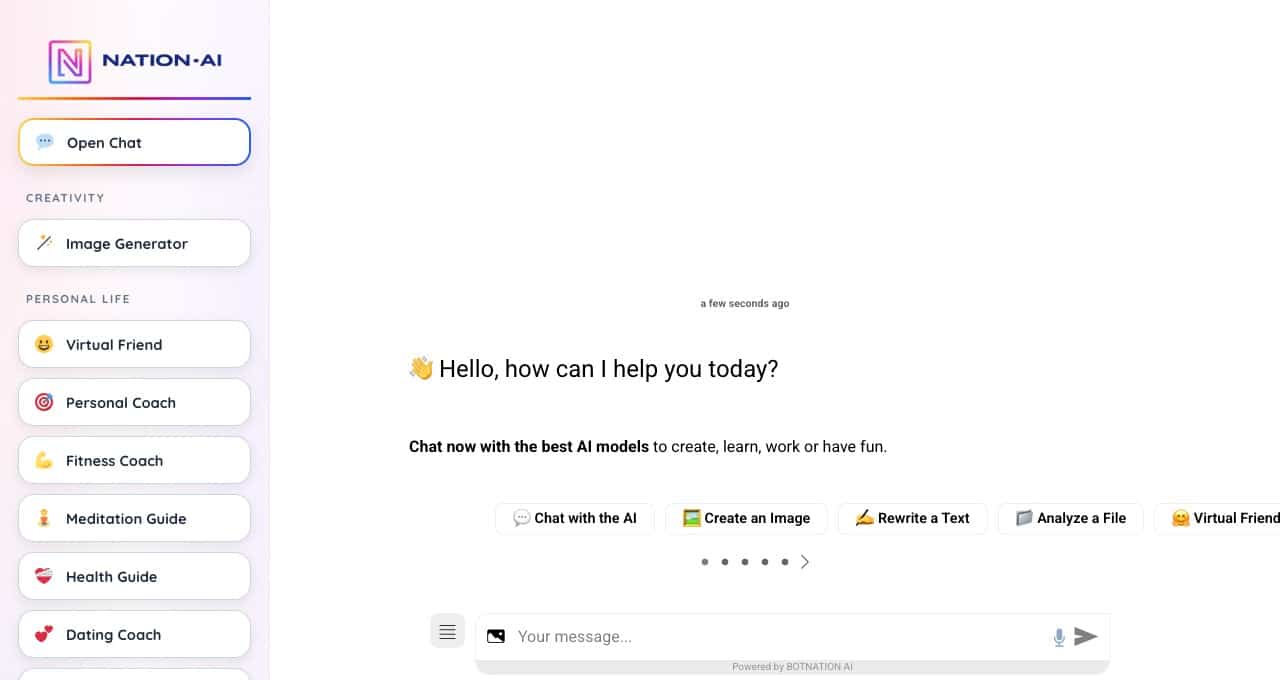
We did not commission this survey out of idle curiosity. Nation.fr runs Nation AI, a French generative artificial intelligence platform whose chat is used every day for exactly this: finding the right words. Its conversation picker even offers a dating coach among its personal life assistants, alongside a style coach and a virtual friend.
Our position on the subject is simple, and it is also what the figures say: AI is useful when it helps you write, and it becomes a problem when it writes for you without anyone knowing. The 32% who would judge “case by case” are probably right.
Frequently asked questions about this survey
How many people were surveyed, and when?
4,106 people living in France, online, from 23 to 30 July 2026, through the BuzzPress panel. The sample was built using the quota method and then weighted on INSEE data (sex, age, socio-professional category, region).
How many people use AI to flirt?
37% of French adults say they used an artificial intelligence in a flirting context at least once during the summer of 2026. Another 29% thought about it without going through with it, which means nearly two out of three do not rule out the practice.
What are these AIs actually used for?
Among users: writing or improving a message (58%), finding something to reply (53%), decoding a message and the other person’s intentions (49%), coming up with date ideas (44%), picking or retouching profile photos (42%), writing a bio (31%).
Do people tell the person they are flirting with?
Rarely. 43% of users never admitted it and the other person never found out, 16% intend never to say so, 13% were suspected or found out. In total, 59% left the other person in the dark. Only 7% said so from the very first message.
How do people react when they find out?
The majority reaction is conditional: 32% would judge by the degree of delegation. Then come the feeling of betrayal (17%), discomfort (15%), disappointment at having been won over by a machine (11%) and immediate cut-off of contact (8%). Only 15% would react with detachment or amusement.
Is it true that AI ranks ahead of family for romantic confidences?
Yes, in our survey. Asked who they turn to first for advice about their love life, 17% of French adults name an artificial intelligence against 14% who name a member of their family. Close friends still come first, at 21%, and 25% confide in no one.
May I reuse these figures and the infographic?
Yes. The results and the infographic from this study may be reproduced freely, provided you credit “Nation.fr survey” and add a link to this page. For any further request, the press contact is given at the end of the article.
Find your words, then write them yourself
Nation AI is a French artificial intelligence that helps you phrase a message, understand a text you received or prepare a delicate conversation. Try the chat for free, with no sign-up, and stay in control of what you send.
Source: Nation.fr survey “AI and seduction, summer 2026”, online study (CAWI) run from 23 to 30 July 2026 among 4,106 respondents living in France, BuzzPress France panel (27,700 people), quota method and weighting on INSEE data. Free to reproduce with the credit “Nation.fr survey” and a link to this page. About Nation.fr: founded by Emmanuel Françoise, Nation.fr is a French generative artificial intelligence platform built to make AI simple, useful and accessible day to day: AI chat, custom assistants, PDF and image analysis, plus many free tools for productivity, writing, learning and automation. The team is based in Paris and Rennes. Press contact: Gildas Piquet-Friboulet, gildas@buzzpress.fr, +33 6 19 93 58 32.