

Key takeaways

No single file format is accepted by all ten hiring systems we checked. PDF works with nine of them and DOCX works with nine too, but not the same nine: SAP SuccessFactors never mentions PDF on its parsing page, and Welcome to the Jungle accepts nothing but PDF.
Published size caps range from 1 MB to 100 MB depending on the vendor. Oracle Taleo stops at 1 MB by default, LinkedIn recommends staying under 2 MB, Welcome to the Jungle and Workable cap at 5 MB. Greenhouse accepts up to 100 MB but writes that above 2.5 MB it no longer reads the content.
The resume produced by a free AI resume builder comes out in two columns, exactly the layout Greenhouse lists among the causes of a failed parse. Tested end to end, file downloaded and opened.
Measurements taken on August 10, 2026 from the official documentation of ten vendors, with screenshots.
Making a resume with AI takes ten minutes. Getting the machine that receives it to actually read it is another matter, and it is the part nobody covers with numbers. The pages ranking for this query all repeat the same common sense advice about columns and tables, without ever naming a single system or quoting a single line of documentation.
We did the opposite. We opened the official help pages of ten systems that receive resumes, recorded what they really accept, then generated a resume with a free AI builder and opened the file it produced. Here is what came out, along with the writing method that goes with it.
What AI writes well, and what it cannot write for you
A language model is good at three things on a resume: turning a vague duty into an active sentence, finding the right verb, and matching vocabulary to a job posting. It is bad at exactly one thing, and that one is decisive: it does not know your career. Anything it adds that you did not give it is an invention, and an invention on a resume gets paid for in the interview.
What you hand over
The phrasing. Going from “I was in charge of stock follow-up” to “ran stock for 1,200 SKUs, cut stockouts from 6% to 2% in eighteen months”. The numbers come from you.
What you also hand over
Spotting the words in the posting that your resume never uses. Paste the ad, ask for the list of missing terms, then keep only the ones that describe something you have actually done.
What you never hand over
Dates, exact job titles, company names, measured results, degrees. A model fills gaps instead of flagging them: it will invent a plausible percentage if you do not supply one.
What it does not do at all
The layout. A chat assistant returns text. You are the one who decides which document that text lands in, and that choice matters more than the phrasing.

The method in five steps
- Gather the raw material first. Titles, dates, companies, cities, three to five accomplishments per role, each with at least one number. Unstructured, no styling. This is the one step AI cannot do.
- Give it the posting along with your material. A resume written without the ad in front of you is a generic resume. Paste the full text of the job posting into the same message.
- Ask for text, not a document. A three line summary, then experience bullets. Turn down every layout suggestion, you do not need one at this stage.
- Check every sentence against reality. Every number, every title, every date. Delete anything you could not defend for twenty minutes in front of a recruiter.
- Drop the text into a plain, single column document. This is the step everyone rushes, and it is the one that decides whether the machine receiving your resume can read it.
The prompt to copy
This template has five blocks: role, material, posting, constraints, output format. Replace what sits inside brackets and leave the rest alone.
Prompt template to copy
You are a recruiter in the [industry] industry. You are reviewing a resume
before it goes out.

MY RAW MATERIAL (everything I give you is true, add nothing) :
- Role : [exact title] at [company], [city], from [month year] to [month year]
- What I did : [3 to 5 accomplishments, with a number whenever I have one]
- Education : [degree, school, year]
- Tools : [software, languages, certifications]

THE JOB POSTING :
[paste the full text of the ad here]

WHAT I WANT :
1. A summary of 3 lines maximum, written without "I", that picks up the
   exact job title from the posting.
2. For each role, 3 bullets that start with an action verb in the past
   tense, one idea per bullet, and one number per bullet whenever my
   material contains one.
3. The list of words from the posting that appear nowhere in my material,
   as a two column table : the word, and why it is missing.

CONSTRAINTS :
- Invent no number, no date, no name, no result. If something is missing,
  write [TO BE FILLED] instead.
- No superlatives, no "passionate about", no "dynamic".
- Return plain text only. No layout, no columns, no tables outside item 3.
The constraint that matters is the second to last one. Without it, a model fills the blanks. With it, it hands you the list of what you are missing, which is far more useful than a smooth piece of text.
Before and after
What you write
Responsible for customer service. Handled complaints and followed up on cases. Strong people skills and a service mindset.
What AI does with it
Handled 45 complaints a week across three channels: phone, email and web form. Cut average first response time from 48 hours to 6 after rewriting the response templates. Trained two interns on the ticketing tool.
The numbers in the right hand column do not come from the model: they come from your raw material. The model only put them in the right place, in the right shape. That is exactly the division of labor to aim for.
What hiring systems really accept
A resume submitted online almost always goes through an applicant tracking system before it reaches a human. That system starts by extracting the text from your file to fill in a candidate record. If it fails, your application still exists, but it arrives empty, and it is up to the recruiter to retype it by hand.
On August 10, 2026 we recorded, from the public documentation of ten vendors, the accepted formats and the published size cap. The table below is the database behind the tool that follows.
| System | Accepted formats | Published size cap | Reads an image resume | Detail found in the documentation |
|---|---|---|---|---|
| Greenhouse | PDF, DOC, DOCX, RTF, TXT | 2.5 MB | No | The file itself can go up to 100 MB, but the help page states that above 2.5 MB the content is no longer parsed. |
| Lever | PDF, DOC, DOCX, RTF, ODT, HTML, WPD | Not published | No | An image file is never parsed, whatever its size. The documentation suggests testing it by highlighting the text with your cursor. |
| SmartRecruiters | PDF, DOC, DOCX, RTF, JPG, PNG | 2 MB | No | A 2 MB per file limit in the application endpoint documented for partners. |
| Oracle Taleo | All formats (default setting) | 1 MB | No | 1,048,576 bytes is the default value of the maximum attachment size setting. It only changes on request to the vendor. |
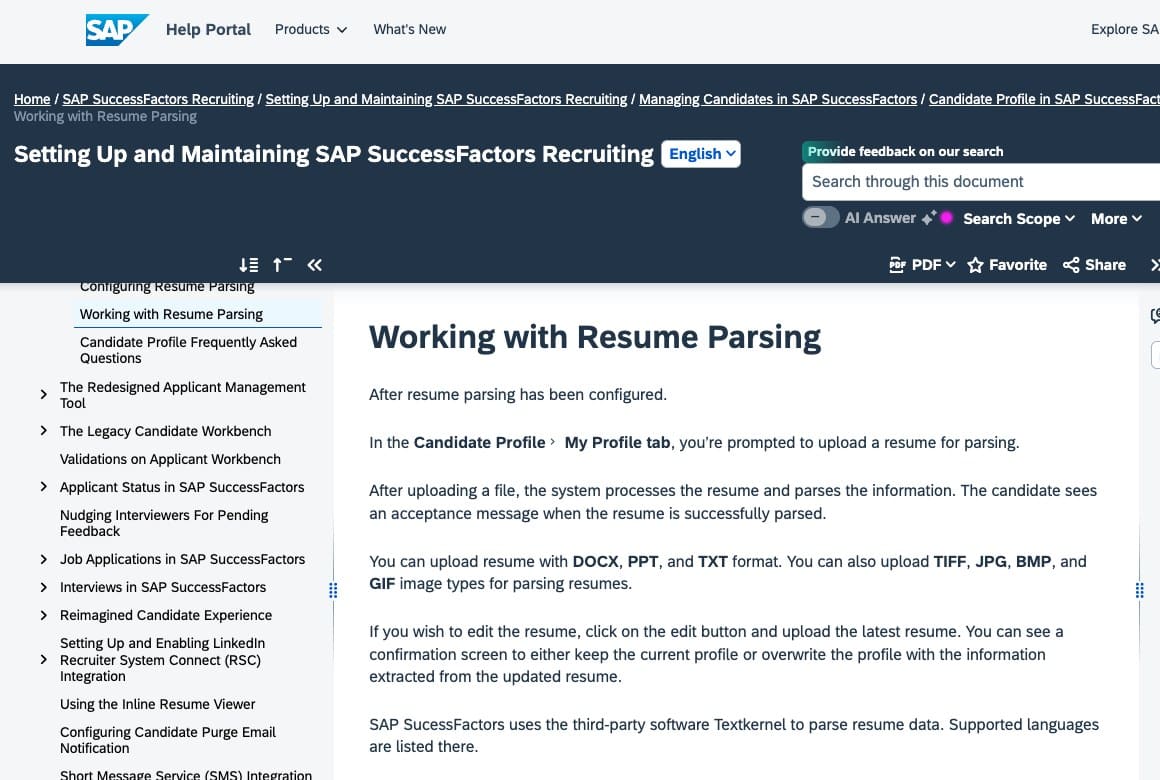
| SAP SuccessFactors | DOCX, PPT, TXT, JPG, TIFF, BMP, GIF | Not published | Yes | PDF does not appear in the format list on the page dedicated to automatic resume parsing. |
| Teamtailor | PDF, DOCX, PPTX, PAGES, TXT, RTF | Not published | No | The only system in the set that lists Apple’s Pages format among the files it reads. |
| Recruitee | PDF, DOC, DOCX, ODT | Not published | No | The troubleshooting page asks you to check that the candidate’s email address can be selected inside the document. |
| Welcome to the Jungle | 5 MB | No | The help center states that only PDF files are accepted and that the document must not exceed 5MB. | |
| PDF, DOC, DOCX | 2 MB | No | The help page recommends a file under 2MB and requires either Microsoft Word or PDF. | |
| Workable | PDF, DOC, DOCX, RTF, HTML, ODT | 5 MB | No | A 5MB cap for resumes, with a shorter format list than the one used for free file uploads. |
The detail that changes the conclusionPDF and DOCX are each accepted by nine systems out of ten, but not by the same nine. PDF is missing at SAP SuccessFactors, DOCX at Welcome to the Jungle. Anyone applying across both worlds needs both files, and no resume builder tells them that.
Checked on August 10, 2026
The same page notes that SAP does not do the job itself: “SAP SuccessFactors uses the third-party software Textkernel to parse resume data.” Several vendors outsource resume parsing this way, which explains why their format lists diverge with no obvious logic.
These findings reflect what vendors publish, not what each employer has configured. An Oracle Taleo customer can raise the 1 MB cap and an SAP customer can enable other formats. The documentation gives the default value: that is what you run into when nobody has changed anything, so in most cases.
Test your file
The tool below applies the table row by row. You can hand it your resume: your own browser reads it locally, nothing is sent anywhere, and only the extension and the size are measured. You can also type everything in by hand.
Will your resume file be read?
Your browser reads the file locally: its extension and its size are measured on your own device and not a single byte is uploaded. You can also type everything in by hand, without providing a file.
The size is listed in the file properties. A one page resume with no photo usually weighs less than 0.1 MB.
8 systems out of 10 will read this file
This file gets through with most of them, not all. The systems listed below will receive an empty candidate record, leaving the recruiter to retype it by hand.
- Oracle Taleo : the file goes over its limit of 1 MB.
- SAP SuccessFactors : this format is not on its list.
Text ready, file not ready? Nation AI writes the text of your resume in plain English. The single column layout is still your job, and it is the one that decides what happens next.
What Greenhouse says it rejects, word for word
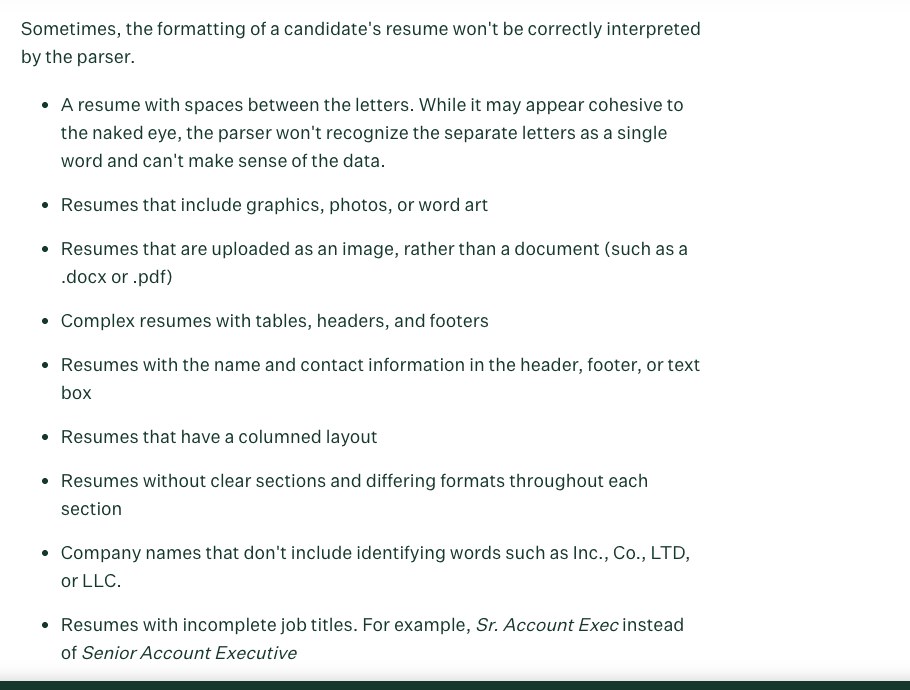
The Greenhouse help page devoted to failed parses is the most explicit of the set. It lists the layouts that break extraction. Here is that list, quoted exactly.
- “Resumes that are uploaded as an image, rather than a document (such as a .docx or .pdf)”;
- “Complex resumes with tables, headers, and footers”;
- “Resumes with the name and contact information in the header, footer, or text box”;
- “Resumes that have a columned layout”;
- “Resumes without clear sections and differing formats throughout each section”;
- “Resumes that include graphics, photos, or word art”;
- “Resumes with incomplete job titles”, with “Sr. Account Exec” instead of “Senior Account Executive” given as the example.
Four of those seven points describe exactly what a modern resume template produces: columns, boxes, contact details in a sidebar, icons. That is the core of the problem, and it has nothing to do with the text the AI wrote.
Checked on August 10, 2026
Lever takes the reasoning further and gives the simplest test there is: “A simple test to gauge if a file’s content is parseable is to try highlighting text in the document with your cursor.” In other words, open your PDF and try to highlight your own name. If the cursor slides across without catching anything, your resume is an image, and none of the systems in the table will read it, except SAP SuccessFactors, which does document parsing image files.
The ten second testOpen your resume, try to highlight your name with the cursor, then paste it into an empty text field. If your name, your email and your phone number come out readable and in that order, automatic parsing will go fine. If nothing gets selected, or if the paste comes out scrambled, you have just seen what the machine sees.
What an AI builder really produces
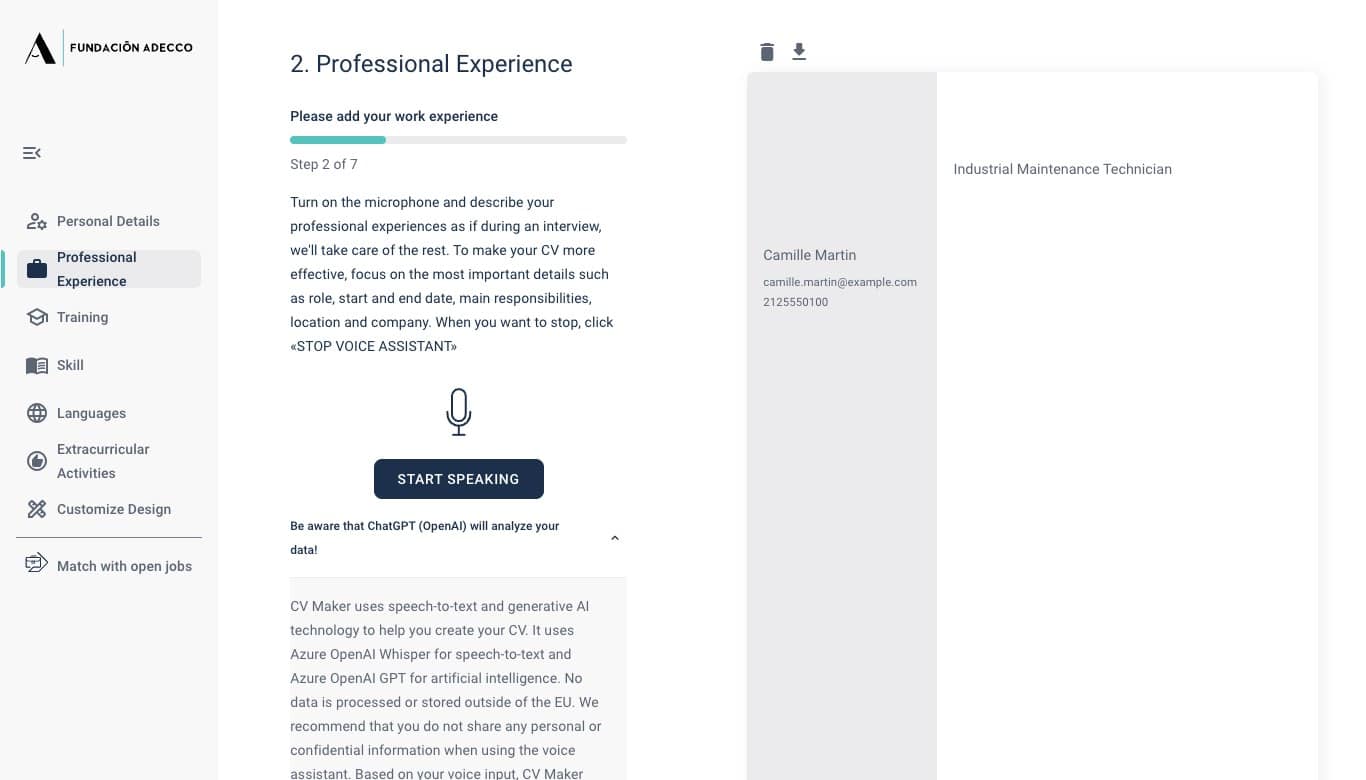
That leaves the question of what the tools promising a resume in three minutes actually put out. We took one, the Adecco Foundation’s CV Maker, for a specific reason: it is free, it asks for no account, and it exists in English as well as in Spanish. In other words, the shortest path between a job seeker and a resume made by AI.
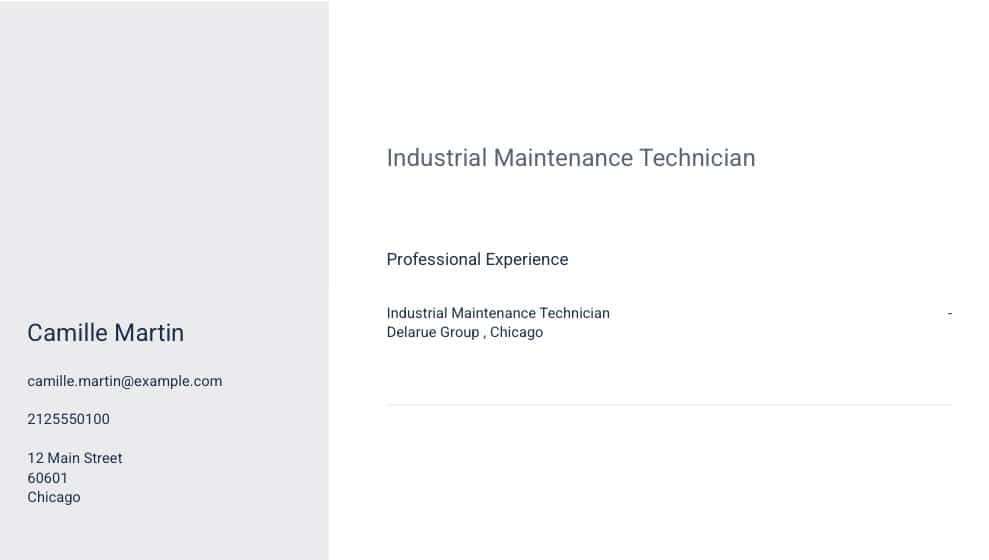
We filled it in with a fictional profile, used the AI assistant for the experience section, downloaded the PDF, then opened the file.
Checked on August 10, 2026
The resulting file has real qualities, and that deserves saying: 87.2 KB, one A4 page, no embedded image, and a single typeface, Roboto Regular. On size it clears every cap, including Oracle Taleo’s 1 MB. On format it clears them too, except SAP SuccessFactors, which does not list PDF. Run through the tool above, the file scores nine systems out of ten, and that is the only blocker.
Then comes the layout.
Checked on August 10, 2026
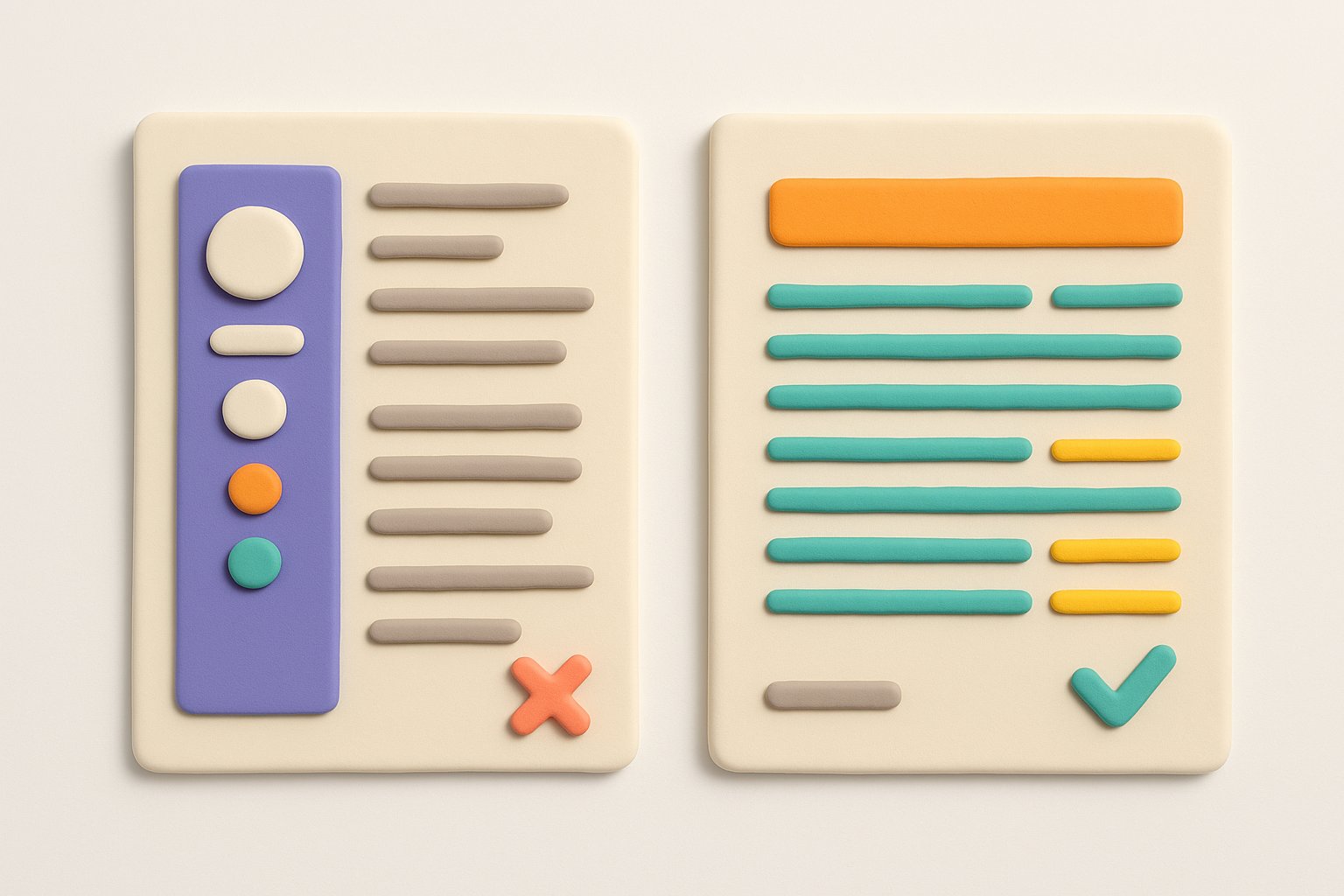
It is a two column resume, with the name and contact details cut off from the content they are supposed to identify. That is one of the seven points on the Greenhouse list, in one shot.
The measurement nobody takesWe pulled the text stream out of the PDF, in the order it is written inside the file. The job title comes first, before the name and before the email address. A human sees a name at the top left with a job title beside it; a program reading the stream in order receives a job title first and has to guess whose it is.
Eleven lines of text extracted, 199 characters. The start and end dates come out as two lone hyphens, and the company and the city end up glued together on one line. None of this stops a human from reading the document: all of it complicates the job of the program trying to turn it into a candidate record.
The conclusion is not that these tools should be avoided. It is that a resume builder optimizes for looks, not for machine reading, and it never warns you. The text it produces is reusable as is: it is the container that needs rebuilding.

The photo, the icons and the header
Three decorative elements show up in every resume template and each one causes a different problem.
| Element | What it becomes when a machine reads it | What to do |
|---|---|---|
| The photo | Greenhouse lists resumes containing photos among the failure cases. A heavy photo also pushes the file size up, and it is that size that stops you at 1 MB with Oracle Taleo. | Keep it if your market expects one, compress it under 150 KB, and prepare a photo free version for online applications. |
| Contact icons | Depending on how they were inserted, they come out as junk characters glued to your email address, or they vanish without breaking anything. There is no way to know without opening the file. | Spell out the address and the phone number, without relying on an icon to say what they are. |
| Header and footer | Greenhouse explicitly lists contact details placed in the header, the footer or a text box as a cause of failure. Recruitee asks you to check that the email can be selected. | Put your name, email and phone number in the body of the document, at the top of the first column, as ordinary text. |
Workday points the same way in its administrator documentation: “Resume parsing results can vary based on resume format and order of words. For best results, use resumes that don’t have images or image-based styles.” The same page notes that two fields are never auto filled, languages and skills, which means a candidate is far better off typing them into the form than trusting the resume to carry them.
Should you say you used AI
The question comes up in every conversation, and it is worth splitting in two. Having used an assistant to draft your resume is not a skill and does not belong on the page. Knowing how to work with AI in your field is a skill, and the guidance on that is public.
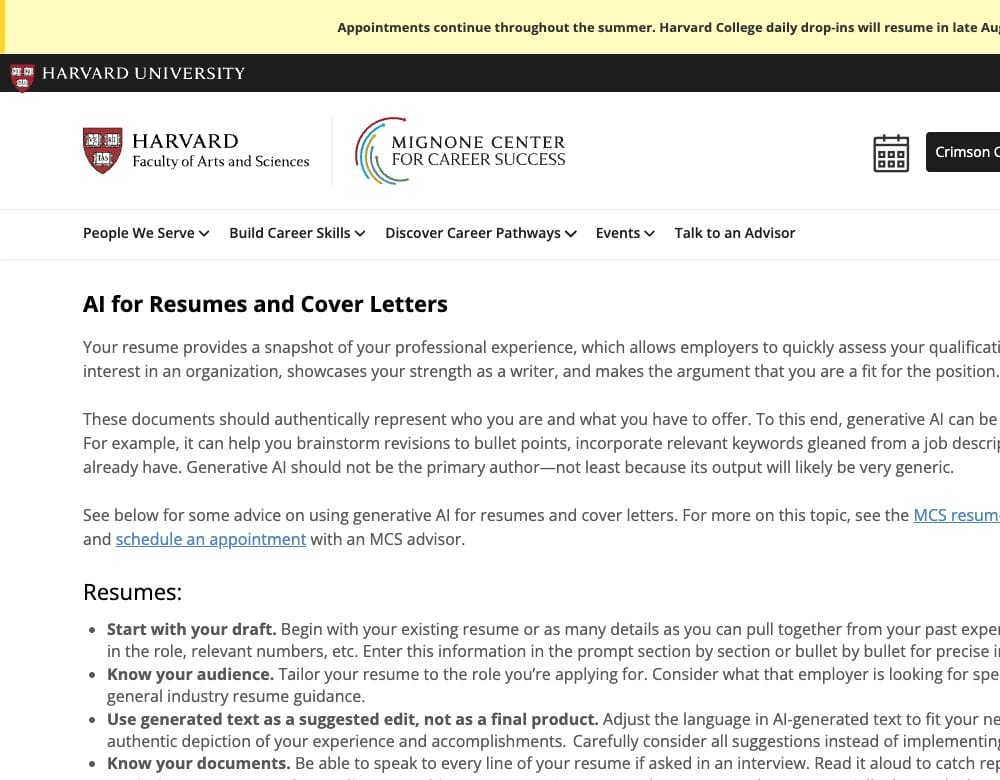
Harvard’s Mignone Center for Career Success devotes a page to using generative AI for resumes and cover letters. Its position is blunt: “Generative AI should not be the primary author”. Three of its recommendations are worth copying as they are.
- “Start with your draft.” Begin with your existing resume, or with as many details from your past roles as you can pull together, including the impact you had and the relevant numbers.
- “Use generated text as a suggested edit, not as a final product.” Adjust the language so it is an accurate and authentic depiction of your experience.
- “Be able to speak to every line of your resume if asked in an interview. Read it aloud to catch repetitions or inaccuracies.”
The same page adds a rule that gets forgotten: “Follow organization guidelines. Read all application instructions, as some organizations may have rules about whether AI can be used in preparing application materials.” Reading the instructions before generating anything costs thirty seconds.
Checked on August 10, 2026
The five mistakes that show
- The suspiciously round number. “Grew revenue by 30%” with no period and no starting point is the signature of generated text. Give the period and the baseline, or drop the number.
- The adjective with no proof. “Detail oriented”, “self starter”, “passionate about”. A model produces these by the yard because they fill space without committing to anything. Replace each one with a fact.
- The vocabulary copied from the ad. Picking up words from the posting is useful; copying all of them turns the resume into a mirror of the ad, and that shows in three seconds.
- The sentence that is too even. Three bullets of identical length, all built the same way, is the rhythm of a model. Break one or two.
- The job title invented in good faith. The most expensive trap. A model short on information writes whatever sounds plausible. Check every title, every date and every company name against your pay stubs.
For the final pass, two habits that work together: run the text through an AI spelling and grammar checker, then read it out loud. What sounds false out loud will sound false in the interview, where you will be asked to expand on those very sentences.
Frequently asked questions
Which file format should you choose for a resume in 2026
PDF first: it is accepted by nine of the ten systems in the set and it locks the layout. Keep a DOCX version handy, it comes in useful when a form refuses PDF, which happens in particular on SAP SuccessFactors installations. In both cases, check that the text can be highlighted with the cursor.
How big should a resume file be
Under 1 MB you clear every published limit in the set, including Oracle Taleo’s default. Between 1 and 2 MB you lose Taleo. Above 2.5 MB, Greenhouse stops parsing the content. A one page resume with no photo usually weighs less than 100 KB: if yours is over a megabyte, an image is almost always the reason.
Is a two column resume really rejected
It is not rejected, it is misread. The file arrives fine and the recruiter can open it. What fails or misfires is the automatic extraction, and the candidate record then arrives incomplete. Greenhouse explicitly lists “Resumes that have a columned layout” among the causes of a failed parse.
Do you have to pay for an AI resume builder
For the text, no: a free chat assistant does the job if you give it your raw material and the posting. What a paid builder sells is the layout and the export, which is precisely the part that should stay plain. A word processor is enough to produce a single column document.
Can AI generate my resume photo
Technically yes, and professional headshot tools have improved a lot. Two reservations: the photo inflates the file, which matters against a 1 MB cap, and an over retouched photo creates a gap between the page and the person who shows up. We measured the real quotas and rights of these tools in our article on the AI professional headshot.
What about the cover letter
Same division of labor: you supply the facts, AI supplies the phrasing. The layout constraint does not apply the same way, since a letter is running text in a single column by nature. Our tool to rephrase text with AI and our article on writing a cover letter with ChatGPT lay out the method.
What to take away
Making a resume with AI works, as long as you know where its job ends. It writes the text, it spots the missing words from the posting, it turns a vague duty into an active sentence. It does not know your career and it does not build a file that the systems receiving it can read.
The move that changes everything fits in one line: drop the text the AI produced into a single column document, with no header, no text boxes, under a megabyte, and check that your name can be highlighted with the cursor. The rest of the work, AI does better and faster than you. To go further on writing prompts, our library of ChatGPT prompt examples also covers the job search.
Write your resume text with Nation AI. Paste your raw material and the job posting, and get back the summary and the experience bullets. Nation AI writes the text, it does not build the layout: you are the one who drops it into a single column document afterwards. Free, and no sign up for the trial.
Primary sources consulted on August 10, 2026: help pages from Greenhouse (accepted formats, failed parses), Lever (resume parsing), SmartRecruiters (application submission), Oracle Taleo (attachment settings, release 22A), SAP SuccessFactors (resume parsing), Workday (resume parsing), Teamtailor, Recruitee, Welcome to the Jungle, LinkedIn and Workable; the Harvard Mignone Center for Career Success page on generative AI for resumes and cover letters. The test resume was generated on the Adecco Foundation CV Maker with a fictional profile, then analyzed offline.