
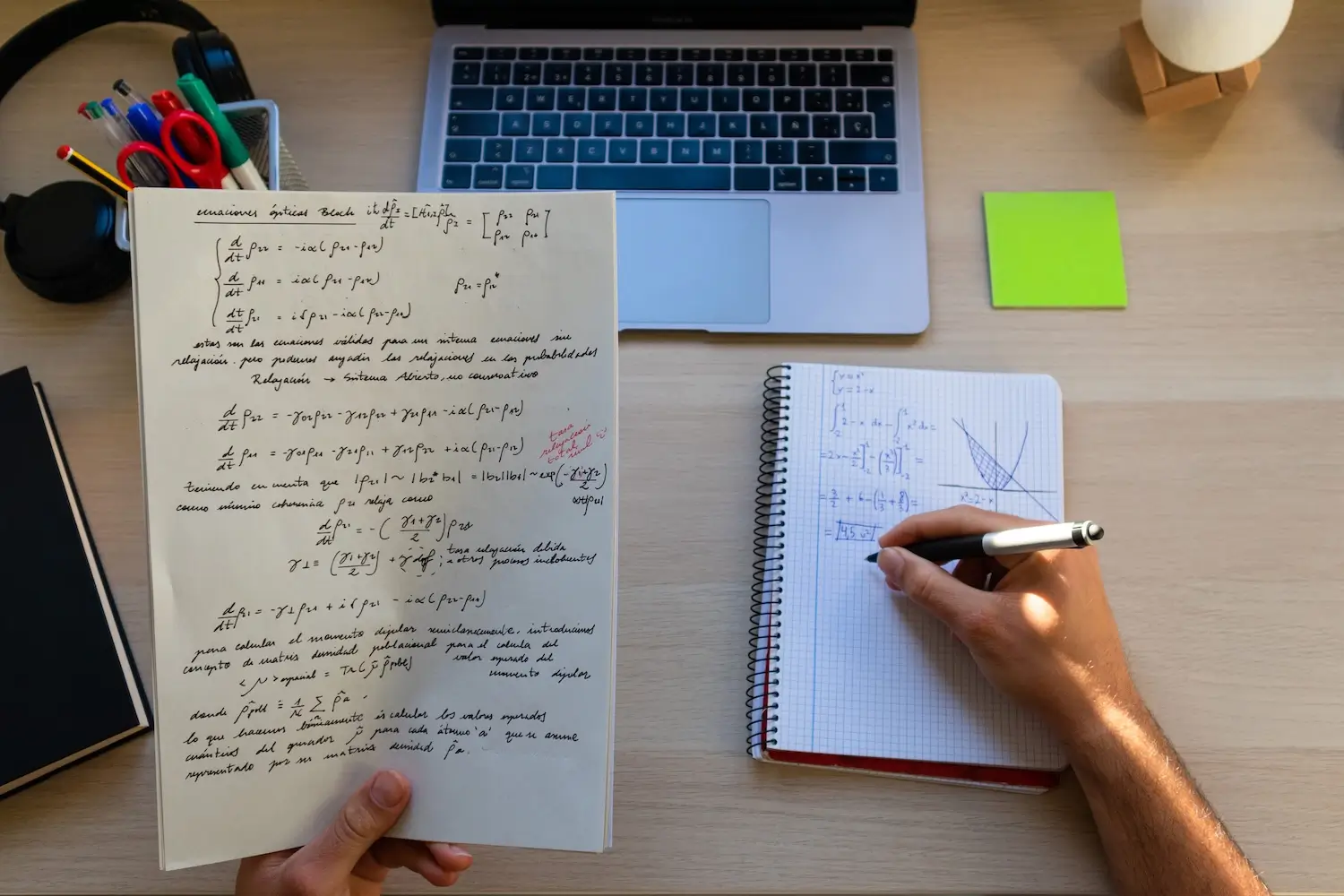
If you’re looking for the best AI for math, you’re primarily seeking a tool that can read a real exercise, whether it’s a photo or a PDF, and then explain the method without overwhelming you. We rank our AI solution for math first. Yes, it’s our solution. And yes, we highlight it because it perfectly meets the real needs of students and parents. We also speak frankly about other tools, as each is different, with its own advantages and disadvantages.

Which AI to choose for math?
Typing “best math AI” into a search engine is often a simple way of saying something else. In practice, users generally want to understand an exercise, check a result, or save time without losing track of the method.
The problem is that many tools promise the same thing. All announce detailed explanations. All claim to cover multiple levels. All assert they can read photos. But in reality, the differences quickly become apparent. A good math AI brings order to a vague problem statement. A less effective one gives a seemingly clean answer, then leaves you alone with your paper.
On this page, we make a clear editorial choice. We put Nation AI first, because it’s our solution, but especially because we believe it is currently very robust for concrete, daily, and French-speaking use. This doesn’t prevent us from being honest about the rest of the market. Some competitors remain excellent for very specific cases. This is precisely what we will show here.
The objective is simple (and practical): to help you choose the best math AI according to your level, your needs, and your way of working.
Our ranking of the best AI tools for math
1. Nation AI, our number 1 choice for general use in French
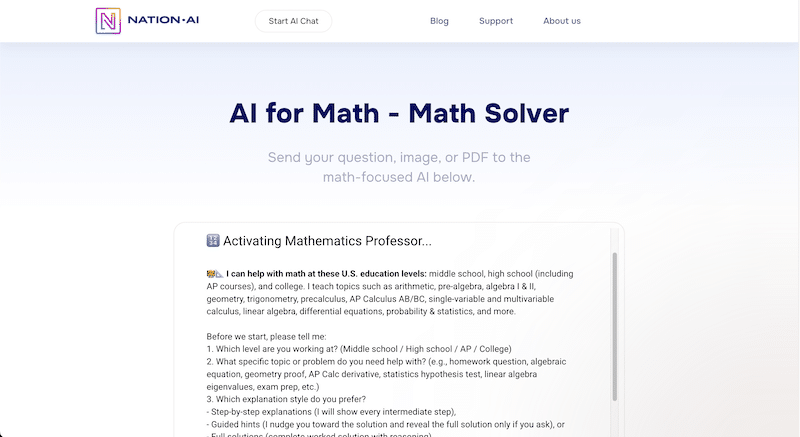
Let’s be frank. Yes, we place Nation AI in first position. It’s not just because it’s our tool. It’s because it responds very well to what most users truly expect from a math AI today. A simple interface. A natural understanding of the need. The ability to send text, a photo, or a PDF. And above all, an ability to explain clearly, without forcing the user to speak like an expert.
This, in our opinion, is the real difference. Many students don’t get stuck on an isolated operation. They get stuck on starting the exercise, on reading the problem statement, on choosing the method, on the first step, on understanding. Nation AI works well precisely in this area. The tool can rephrase, detail, correct, go slower, explain with easy-to-understand concepts, and then adapt the level of explanation if you ask (and this point is more valuable than it seems).
Another important advantage is the fluid experience in French. For a middle schooler, high schooler, student, or parent, this matters. You can ask “explain it like you would to a 4th grader” or “give the method first, then the solution.” This flexibility makes the tool more useful for learning, not just for speed.
Concrete example: You have a photo of a probability exercise with a somewhat complex problem statement. You can ask: “Read the exercise, summarize the logic, explain the probability tree, then solve it step-by-step.”
The same logic applies to a PDF of derivatives. You can target exercise 4, ask for a detailed correction, then a similar exercise to check your understanding. This is exactly the kind of real-world use for which we designed the tool.
So, we say it without hesitation. We put Nation AI first because we believe in its quality, and because it covers the most frequent use very well. That said, it doesn’t replace all specialized tools. And for certain advanced needs, other solutions may perform better. That’s why they also have their place in this ranking.
2. Wolfram|Alpha, excellent for advanced math and symbolic computation
Wolfram|Alpha remains a very serious benchmark as the level increases. Integrals, matrices, differential equations, symbolic calculation, heavier mathematical objects—all of this falls within its domain.
Its great strength is its computational power and rigor. If you are in university, preparatory classes, engineering school, or dealing with topics beyond the classic school curriculum, it can go further than many more general tools.
We rank it behind Nation AI, not because it’s inferior in pure math, but because it’s less accessible for a large portion of users. It often requires more precise input, a bit more technical, and some familiarity with how to formulate a problem. For advanced uses, however, it remains an excellent choice.
3. Symbolab, very good for visualizing steps
Symbolab has a quality that many users immediately look for. It slows down at the right moment. It shows the steps, the mechanics, the logical order, and makes visible transformations that students sometimes do approximately.
For algebra, equations, trigonometry, derivatives, and calculation exercises, it is often very useful. You better understand what happens between the starting line and the finish line. For someone studying alone, this is a real strength.
If your absolute priority is to see a step-by-step breakdown as clearly as possible, Symbolab can be more comfortable than more conversational tools. We place it behind Nation AI because, in our opinion, it is a little less versatile in terms of input formats and overall support. But for procedural pedagogy, it largely deserves its place.
4. Photomath, very practical for quickly scanning an exercise
Photomath has retained what made it successful. You open the app, scan, and quickly get a reading of the problem and a solution. For classic exercises on mobile, it’s very effective.
Its value is obvious for quick use. Between classes, during revision, or to check a calculation before proceeding, it removes a tiny but repeated friction. And this fluidity is, rightly so, popular with many users.
However, we are more reserved when the problem statement becomes richer, more textual, or less visually clean. It’s not necessarily the most comprehensive tool for supporting long-term progress. On the other hand, for mobile scanning and immediate verification, it remains very good.
5. ChatGPT, useful for rephrasing, explaining, and creating variations
ChatGPT is not a specialized math solver in the strict sense, but it remains genuinely useful in a comparison like this. It can rephrase a problem statement, popularize a concept, create similar exercises, propose a mini-quiz, or transform a correction into a revision sheet.
It is particularly interesting for written problems, comprehension questions, demonstrations to comment on, or errors to analyze. When you want to discuss a method, it has a flexibility that many specialized tools lack.
We place it in fifth position because it often requires more precise framing. Without clear instructions, the answer may be correct but too vague. Used well, it’s a very good companion. Poorly framed, it can lack precision in strict calculations.
Comparative table of the best AI tools for math
| Tool | Ideal for | Strengths | Limitations | Our opinion |
|---|---|---|---|---|
| AI Nation | General use in French, homework, revisions, photo and PDF | Simple, clear, in French, accepts text, image and PDF, good for explaining and correcting | Less specialized than some expert engines for very technical cases | Our number 1 choice for most users |
| Wolfram|Alpha | Advanced math, symbolic calculation, higher education | Very powerful, rigorous, strong on complex mathematical objects | Less intuitive for beginners, more technical in use | Excellent when the level becomes demanding |
| Symbolab | Step-by-step understanding | Details steps well, pedagogical, good for algebra and calculation | Less versatile for certain formats and uses | Very good for learning the method |
| Photomath | Quick scan on smartphone | Very fast, practical, accessible, effective for classic exercises | Less comfortable with long or more ambiguous problems | A very good mobile reflex |
| ChatGPT | Explanations, rephrasing, exercise variations | Versatile, flexible, useful for popularizing and discussing | Requires good framing, variable precision depending on the request | A good complement, less a pure solver |
What a good math AI should really be able to do
A good math AI isn’t judged by a perfect demonstration in a showcase. It’s judged by slightly less clean situations. An imperfect photo. A poorly formulated problem statement. An incomplete question. A student who doesn’t even know the name of the method they need to apply.
These are the criteria that truly matter:
- explain the method, not just give the answer
- recognize an exercise typed, photographed, or sent as a PDF
- adapt to the requested level (6th grade, 10th grade, 12th grade, university)
- show intermediate steps without removing useful transitions
- correct a student’s attempt instead of solving everything at once
- propose a similar exercise to check understanding
- remain clear even if the user doesn’t master the exact mathematical vocabulary
This last criterion is often underestimated. Many users don’t say “solve this quadratic equation using the discriminant.” They rather say “I’m stuck on the exercise with delta.” A good math AI must understand this reality too.
How to choose the best math AI according to your needs
There isn’t one single best math AI for everyone. There is primarily the right tool at the right time. It’s less spectacular, but much more useful.
- If you are a middle or high school student, with exercises taken as photos, homework, course sheets in PDF, and the need for a clear explanation in French, Nation AI seems to us the most coherent choice. This is precisely the type of use for which we developed it.
- If you are dealing with denser formal calculation, more demanding integrals, heavier systems, or advanced mathematical objects, Wolfram|Alpha can become a better tool. We must frankly admit it. Its computational power remains a true benchmark.
- If your priority is to see the steps very clearly, Symbolab retains a real advantage. It is not the broadest in its approach, but it is methodical, readable, and reassuring.
- If you primarily work on your phone and want to quickly check an exercise, Photomath remains very practical. It’s the tool for a quick reflex, not necessarily for the most in-depth work.
- Finally, if you need to rephrase a problem statement, popularize a concept, create a revision quiz, or transform a correction into a simple sheet, ChatGPT remains interesting. It doesn’t replace the best specialized tools, but it can effectively complement a workflow.
Why we put Nation AI first
We could adopt a falsely neutral discourse. It would be neither very elegant nor very useful. We prefer to be transparent. We highlight Nation AI because it is our solution, and because we sincerely believe it deserves this place for the broadest use.
Our reasoning is simple. The majority of users don’t need the most technical engine on the market every day. They need a tool that quickly understands the request, accepts the most common formats, speaks clearly in French, and then helps them progress without unnecessary complexity.
This is exactly the promise on which we built Nation AI. And that’s also why we believe we can put it first without distorting reality. Saying this doesn’t mean that other tools are inferior in all aspects. That would be false. Wolfram|Alpha can go further on certain advanced calculations. Symbolab can be more rigid, but also more demonstrative on certain steps. Photomath remains formidable for mobile scanning. ChatGPT retains appreciable flexibility.
Our position is therefore as follows. If you are looking for the most balanced tool for concrete, French-speaking, pedagogical, and daily use, Nation AI seems to us to be the best choice. If you have a very specialized need, other solutions may occasionally come out on top. And that’s normal.
Our tips for getting much better answers
The most effective approach is not to write a complicated prompt. The most effective approach is to be precise. Clear instructions, even short ones, often significantly improve the quality of the response.
Some simple formulations work very well. “Explain it like you would to a 10th grader.” “Show the numbered steps.” “Correct my attempt and tell me where I went wrong.” “Solve it, then suggest a similar exercise.” “First give the method, then the solution.”
Example. For a derivative, instead of writing “do the exercise,” try this: “Differentiate f(x) = (3x – 2)² and explain the chain rule as if I were seeing it for the first time.” The answer immediately becomes more useful.
Another very practical example for revision. Take a course PDF, then ask: “Summarize the method for solving a product-null equation, then create 3 exercises of increasing difficulty with solutions.” Here, the AI no longer just answers. It helps you progress.
Limitations to know before choosing a math AI
No AI is infallible. Poorly read data, an ambiguous symbol, a photo that’s too dark, an overlooked implicit assumption, and the solution can go down the wrong path. It’s therefore important to maintain a simple habit: check the final result and see if the method makes sense.
Another point is that an AI can sometimes go too fast. The problem isn’t technical. It’s pedagogical. When everything comes at once, the student might think they’ve understood when they’ve simply recognized the form of the answer. To avoid this, it’s better to ask for short steps, or a two-stage solution (method then application).
Finally, a math AI doesn’t completely replace a teacher. It helps, corrects, rephrases, unblocks, repeats. But it doesn’t follow your progress over several weeks like a teacher or good human support can.
FAQ on the best math AI
What is the best math AI for a high school student?
For a high school student who wants clear help, in French, with the ability to send a photo or PDF, Nation AI seems to us the best overall choice. For more advanced calculations, Wolfram|Alpha remains excellent. For pure step-by-step, Symbolab is very solid.
What is the best free math AI?
It all depends on what you expect from free access. For quickly testing a simple use, Nation AI is a good entry point. For an occasional mobile need, Photomath may suffice. However, many tools reserve their most advanced features for paid offerings.
Can a math AI solve an exercise from a photo?
Yes. Several tools do this well. Photomath is known for it. Nation AI also allows it, with a broader approach, as you can also work from text or PDF in a conversational logic.
Which AI to choose for advanced math?
For integrals, matrices, differential equations, and more demanding symbolic calculation, Wolfram|Alpha remains one of the most solid references. It’s an excellent choice for technical needs. Nation AI can also handle complex requests. The simplest way is to send it a photo of your problem statement or your handwritten notes.
Which AI is the most pedagogical for learning the method?
Symbolab is very good for detailing the steps. Nation AI is also very useful if you ask it for a specific format, for example, an explanation adapted to your level, a correction of your attempt, or a similar exercise for practice.
Is ChatGPT a good AI for math?
Yes, especially as a versatile tool. It is useful for rephrasing, explaining, creating variations, and discussing a method. For pure and very systematic mathematical calculation, specialized tools often retain the advantage.
Can you use a math AI without cheating?
Yes, of course. If you ask for a method, a correction of your attempt, an explanation of an error, or a practice exercise, you are in a learning mindset. The problem is not the tool. The problem primarily comes from how it is used.
In conclusion, if you are looking for the best math AI for real, comprehensive, and comfortable use, we recommend Nation AI. We do so openly, because it is our solution, and because we believe it responds very well to the most frequent needs. This does not prevent us from recognizing the value of other players. Wolfram|Alpha is formidable for advanced math. Symbolab is excellent for step-by-step. Photomath remains very practical on mobile. ChatGPT offers real conversational flexibility. The right choice therefore depends on the context, but for general use in French, our preference remains clear.